
In 1996, FBS college football decided to institute overtime in order to eliminate ties.
The rules allowed for each team to get the ball at their opponents' 25-yard-line, forcing both teams to play both offense and defense in order to win the game.
The game would go on as long as possible until after an overtime period where the game was not tied anymore.
While overtime eliminated the pesky ties, it did allow for marathon games where the game could go on for multiple overtimes before a winner was decided.
That's exactly what happened on November 3, 2001 when the Arkansas Razorbacks traveled to Oxford, Mississippi to take on the Ole Miss Rebels in the first of five games to go to seven overtime periods in college football history.
Ole Miss entered the game on a five-game winning streak which included a 35-24 win at LSU the previous week to give the Rebels a 6-1 record and a chance to win the SEC West Division title, which would earn the Rebels their first trip to the SEC Championship Game.
The Rebels were coached by David Cutcliffe, who was in his third season at the helm at Ole Miss, and were led by sophomore quarterback Eli Manning, younger brother of Peyton, who Cutcliffe had coached at the University of Tennessee, and son of Archie, who was an legend at Ole Miss setting numerous record during his career from 1968-70.
The Rebels' opponents, the Arkansas Razorbacks entered the game with a 4-3 record after going 0-3 in the month of September.
The Razorbacks were coached by Houston Nutt, who was in his fourth year as head coach of the Hogs, which relied on a potent running game which junior running back Fred Talley and redshirt sophomore Cedric Cobbs.
The game was set up as an interesting contrast of styles with the Arkansas running attack going up against the Ole Miss passing offense.
Little did anyone know they would participate in one of the longest games in college football history.
After the Razorbacks punted on their opening possession, the Rebels took over at their 20-yard-line and proceeded to drive 80 yards in 11 plays, culminating with a one-yard touchdown run by Joe Gunn to give Ole Miss a 7-0 lead midway through the first quarter.
Gunn's touchdown would be the only score of the first quarter as the Rebels took their 7-0 lead into the second quarter when the Hogs mounted their first scoring threat of the game when they drove from their 40-yard-line to the Ole Miss 28-yard-line after six straight running plays picked up 32 yards.
But on the seventh play of the drive, the Hogs decided to go to the air as quarterback Zak Clark dropped back to pass, only to be intercepted by Ole Miss linebacker Kevin Thomas to end the Arkansas drive and preserve the Rebels' 7-0 lead.
Following an exchange of punts, the Hogs would get the ball back at their 20-yard-line with 4:25 left in the first half.
The Hogs stuck to the ground as they Talley ran the ball five straight times for 21 yards, before Cobbs got a carry as he picked up 10 yards on a 3rd & 1, putting Arkansas in Ole Miss territory with a 1st down at the Rebels' 49-yard-line.
But two plays later, the Hogs were faced with a 3rd & 14 at their 47-yard-line when they called timeout with 1:07 left before halftime.
That is when the Hogs decided to go to the air as Clark completed four straight passes, three of them to George Wilson, gaining 51 yards to set up Cobbs' two-yard touchdown run that tied the game at 7 with just 20 seconds left in the half.
 |
| Fred Talley(20) breaks through Ole Miss tacklers as he would run for 113 yards on 23 carries. |
Ole Miss got the ball to start the second half and were at the Arkansas' 14-yard-line in just three plays as Manning connected with tight end John Ziegler for a 56-yard pass play, then hit Ziegler again for 11 yards to set up 1st & goal from the three-yard-line.
But the Razorback defense stiffened and forced the Rebels to attempt a 20-yard field goal, only to have Jonathan Nichols' kick sail wide right keeping the game tied 7-7 with 12:43 left in the third quarter.
The Hogs took over at their 20-yard-line after the missed field goal and drove 44 yards on ten straight running plays until Clark connected with Wilson for six yards on a 3rd & 4 to give Arkansas a 1st down at the Ole Miss 30-yard-line.
However on the very next play, Talley fumbled the football after a hit by Thomas, which was recovered by Rebels linebacker Eddie Strong, ending the drive and giving Ole Miss the ball back at their 29-yard-line.
The Rebels would go three-and-out on their ensuing possession, forcing a punt which was shanked by Cody Ridgeway, going only 16 yards and giving Arkansas the ball at the Ole Miss 42-yard-line.
The Hogs could only drive 14 yards to the Rebels' 28-yard-line but it was still good enough for Brennan O' Donohue to kick a 45-yard field goal to give Arkansas a 10-7 lead with 5:32 left in the third quarter.
Jason Armstead would return the ensuing kickoff 53 yards to the Arkansas 40-yard-line, which would lead to a 32-yard field goal by Nichols to tie the game at 10 with 2:05 left in the third quarter.
Following the Ole Miss field goal, the Hogs would get the ball back at their 15-yard-line where on the first play of the drive, Clark would connect with Wilson for 10 yards and a 1st down at the 25-yard-line.
That would be the only pass of the drive as the Hogs would run the ball 13 straight times, with Mark Pierce getting the bulk of the work on the drive as he carried the ball six times for 32 yards, including a two-yard touchdown run to put Arkansas back on top, 17-10 with 10:18 left in the fourth quarter.
The Rebels would begin their next possession at their 28-yard-line as Manning would complete six of eight passes for 48 yards on a 13-play drive which ended with a three-yard touchdown pass from Manning to Armstead that with Nichols' extra point tied the game at 17 with 4:50 left in regulation.
Arkansas got the ball at their 17-yard-line with a chance to drive for the winning score but the drive stalled at the Ole Miss 46-yard-line forcing the Hogs to punt the ball back to Ole Miss, who took over at its seven-yard-line with 1:47 to go in regulation.
Even though his team had two timeouts left, Cutcliffe decided to play it conservatively and just run the ball three straight times to run out the clock and send the game into overtime with the game tied 17-17.
The Rebels won the overtime coin toss and elected to play defense, so they know whether they needed a field goal or touchdown when they got the ball.
With the ball at the Ole Miss 25-yard-line, the Hogs ran the ball three straight times picking up nine yards, setting up 4th & 1 at the 16-yard-line and presumably a field goal attempt.
But Nutt gambled and decided to go for the 1st down which he got and more as Cobbs busted through for a 16-yard touchdown run to give Arkansas a 24-17 lead.
The Rebels would get their chance to tie the game, but would be faced with a do-or-die 4th & 6 at the Arkansas 11-yard-line.
That is when Manning found Armstead for a 11-yard touchdown that along with Nichols' extra point tied the game at 24 and send the game into a second overtime.
The Rebels would begin the second overtime on offense and seemed to poise for another touchdown as they had 3rd & goal at the three-yard-line.
However, Manning would fumble a shotgun snap, which was recovered by Arkansas defensive lineman Curt Davis at the ten-yard-line, giving the Hogs a chance to win the game with a field goal.
Cobbs would run the ball three straight times, picking up seven yards, to set up a potential game-winning 35-yard field goal by O' Donohoe.
But O'Donohoe's kick sailed wide right, keeping the game tied 24-24 as the game went into a third overtime.
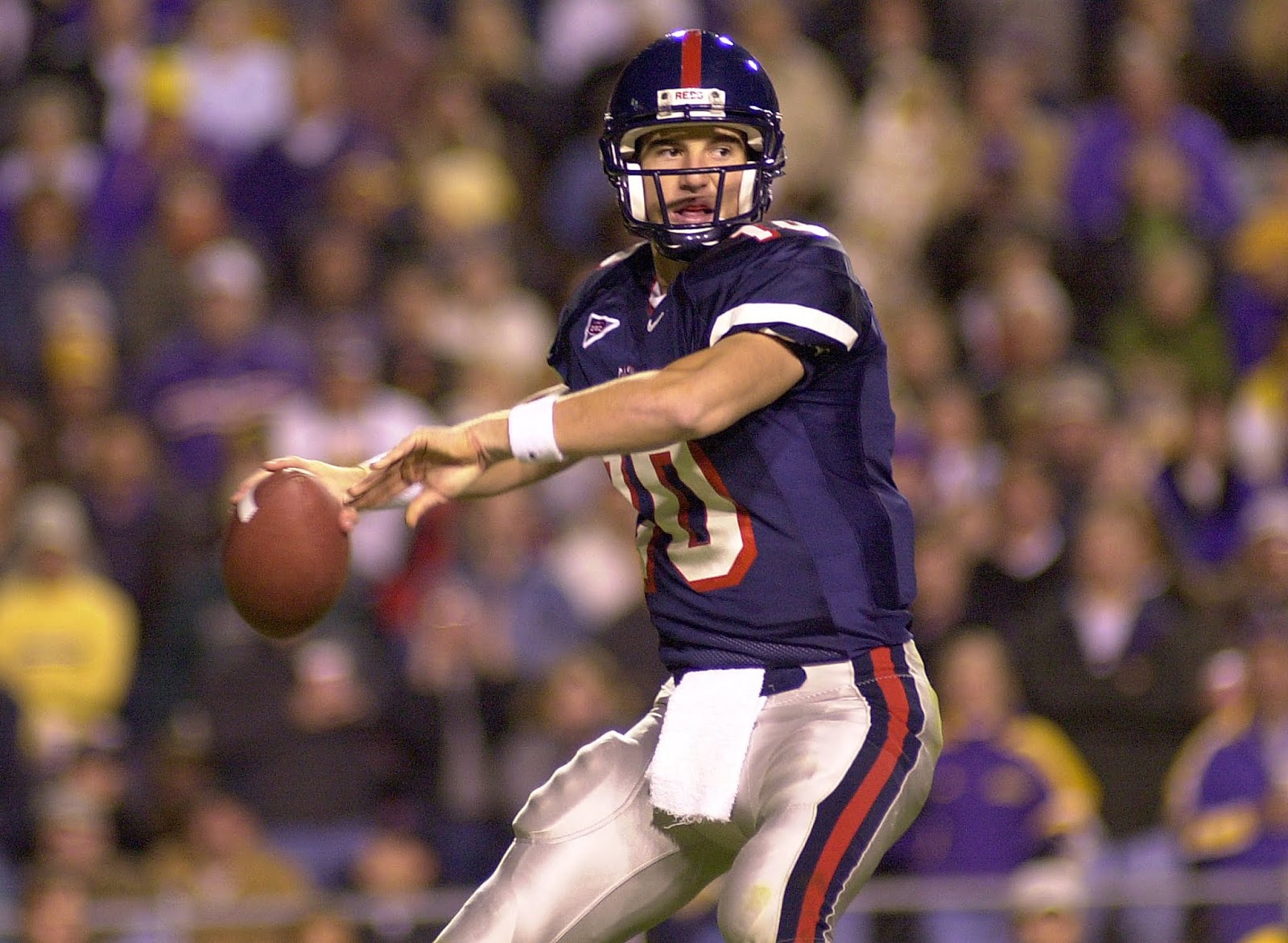 |
| Eli Manning would throw for six touchdown passes, with five of those coming in the seven overtime periods. |
It would take the Hogs one play to get into the end zone as Jones ran it in for a 25-yard touchdown to give Arkansas a 30-24 lead.
As the game had now entered the third overtime period, teams were now required to go for two after every touchdown.
Jones handed the ball to Decori Birmingham who was stopped short of the end zone, keeping it 30-24 in favor of the Hogs as the Rebels would prepared for their offensive possession in the third overtime.
That is when Ole Miss did their best Arkansas impression as they ran the ball five straight times, ending with an one-yard touchdown run by Gunn to tie the game at 30 and give the Rebels a chance to win the game with their two-point conversion attempt.
But Manning's two-point pass fell incomplete and the game would go into a 4th overtime period tied 30-30.
After hitting running back Charles Stackhouse for four yards, Manning would find Bill Flowers for a 21-yard touchdown to put Ole Miss back on top 36-30.
However, the two-point conversion would fail as Manning's two-point conversion pass would sail over the head of wide receiver Jamie Armstrong, opening the door for Arkansas to win the game if they could score a touchdown and convert on a two-point conversion.
After Jones, who at this point had taken over for Clark at quarterback, only ran for one yard on 1st down, hit Wilson for a 24-yard touchdown pass to tie the game at 36.
Once again, Jones handed the ball off to Birmingham, who once again was tackled short of the end zone, sending the game into a fifth overtime period and making this game the first game in college football history to go at least five overtimes.
The Hogs would start the fifth overtime on offense where it took them four plays to get into the end zone as Jones would run it from eight yards out to give Arkansas a 42-36 lead as his two-point pass intended for Pierce fell incomplete.
When Ole Miss got the ball for their possession in the fifth overtime, they started off by running the ball as Gunn carried the ball three straight times for 13 yards, before Manning found tight end Doug Ziegler for a 12-yard touchdown pass to tie the game at 42.
But for the third straight time, Manning would throw an incomplete pass on the Rebels' two-point conversion attempt, forcing a sixth overtime period as both teams had now scored more points in the five overtime periods then they did during sixty minutes of regulation.
It would take only two plays for the Rebels to get back into the end zone as Manning connected with Stackhouse for 10 yards, then found Ziegler for a 15-yard touchdown to give Ole Miss a 48-42 lead before the two-point conversion attempt.
This time, Ole Miss would make the two-point conversion as Stackhouse would run it in for the two-point conversion to increase the Rebels' lead to 50-42 as Arkansas prepared for their possession in the sixth overtime period.
Jones would hit tight end Nathan Bell for 23 yards to set up a two-yard touchdown run by Pierce to cut the Rebels' lead to 50-48 as the Hogs prepared for the two-point conversion they needed to make in order to force a seventh overtime period.
That is when Jones connected with Jason Peters, a defensive end who lined up at tight end, for the game-tying two-point conversion to tie the game at 50 and send into another overtime period.
 |
| Arkansas quarterback Matt Jones took over for Zak Clark and ran for 110 yards and two touchdowns as the Razorbacks ran for 371 yards on 80 rushing attempts. |
The Hogs would run the ball six straight times, gaining 23 yards to set up a 4th & 1 at the two-yard-line, when Nutt gambled again and decided to go for the 1st down instead of the field goal.
The gamble paid off as Pierce would score his third touchdown of the game to give Arkansas a 56-50 lead which became 58-50 after Jones connected with Birmingham on the two-point conversion.
When the Rebels got the ball for their possession in the seventh overtime frame, it would take them six plays to drive to the six-yard-line where they faced a do-or-die 4th & 2.
That is when Manning hit Armstead for three yards and a 1st down, which would followed by a three-yard touchdown pass to Armstead to cut the Arkansas' lead to 58-56 as the Rebels prepared for the two-point conversion that they needed to make in order to keep the game going.
Manning would complete a pass to Ziegler, but he was tackled by Arkansas linebacker Jermaine Petty at the two-yard-line, ending the longest game in college football history as the Razorbacks had come away with a 58-56 win in a 4-hour, 14-minute game which saw both teams combine for 198 plays, 988 yards of total offense and 114 points scored.
The seven-overtime loss to the Razorbacks was the first in a three-game losing streak of the Rebels which saw Ole Miss' dreams of going to the SEC Championship Game go up in smoke as they lost to Georgia and Mississippi State, before defeating Vanderbilt to end the season with a 7-4 record, but no invitation to a bowl game.
Manning would lead the Rebels to a bowl game the following season as the Rebels defeated Nebraska in the 2002 Independence Bowl, then would win 10 games in 2003 including a victory in the Cotton Bowl as Manning finished third in the race for the Heisman Trophy.
Eli would then go on be to the #1 overall pick in the 2004 NFL Draft, but refused to play for the Chargers who picked him #1, forcing a trade to the New York Giants, to which he lead them to two Super Bowl victories.
As for the Razorbacks, they would finish the 2001 season with a 7-4 regular season record, earning them an invitation to the Cotton Bowl, which they lost to Oklahoma.
The following season, Arkansas would win the SEC West to go the SEC Championship Game for the first time since 1995, only to lose to Georgia 30-3.
This was followed by a 9-4 season, which included another seven overtime game, this time with Kentucky, which the Razorbacks won 71-63.
Three years later, North Texas and Florida International would play in a seven-overtime game which North Texas won 25-22.
It wouldn't be until 2017 when another seven-overtime game would occur in FBS college football when the University of Buffalo defeated Western Michigan 71-68 after seven overtimes.
Then in 2018, LSU and Texas A&M played in not only the fifth seven-overtime game in college football history, but also the highest scoring game in college football history as the A&M defeated LSU 74-72.


