Monday, November 20, 2017

College Football Old School Game of the Week: Auburn Beats Bama in First Iron Bowl at Jordan-Hare

For Auburn fans it was a day they thought they never see: the Alabama Crimson Tide coming to Jordan-Hare Stadium to face off with their beloved Tigers.
But on December 2, 1989, that very thing happened as the “Iron Bowl” was played at in front of a partisan Auburn crowd for the first time in the history of the rivalry.
When the Auburn-Alabama rivalry resumed playing in 1948 after a 41-year hiatus, it was played at Legion Field in Birmingham, the largest football stadium in the state of Alabama.
All subsequent games were played in Birmingham with ticket sales spilt 50-50 between both teams.
But in the minds of Auburn fans, Legion Field was seen as enemy territory as Alabama would play up to three games per year at Legion Field and statue of famed Bama head coach Paul “Bear” Bryant stood in front of the stadium.
Auburn fans clamored for the game to become home-and-home and allow for the game be played at the Plains, but Alabama officials offered up a number of reasons such as the size of Jordan-Hare Stadium compared to Legion Field.
But by the start of the 1980 season, Jordan-Hare had exceeded Legion Field in capacity, but Alabama still refused to move the game leading to Bryant’s successor at head coach, Ray Perkins, to say that the game would never be played in Auburn.
Finally after the contract to keep the game in Birmingham through 1988 expired, Alabama to have the “Iron Bowl” be played in Auburn on December 2, 1989.
If it were not enough that the Crimson Tide were coming to Auburn for the first time, this game had national and SEC championship implications as the Tide entered the game with 10-0 record and ranked #2 under third-year head coach Bill Curry, who had not defeated Auburn during his reign in Tuscaloosa.
Auburn was ranked #11 with a 8-2 record but defeating Alabama would earn the Tigers a piece of the SEC championship, making it the third straight year and fourth time that Auburn had won at lead a share of the SEC title since Pat Dye become head coach in 1981.
Alabama head coach Bill Curry and Auburn head coach Pat Dye meet before the 1989 Iron Bowl, the first time the game was played in Auburn.

Auburn got the ball first and drove 68 yards in seven plays, with the big play being a 44-yard pass from quarterback Reggie Slack to Alexander Wright, for the game’s first touchdown, a 1-yard touchdown run by James Joseph to give the Tigers a 7-0 lead just 2:50 into the game.
Alabama went nowhere on their opening drive and were forced to punt, only to get the ball back when defensive tackle George Thornton recovered a fumble at the Auburn 21-yard-line, which led to a 24-yard field goal by Philip Doyle to cut the Tiger lead to 7-3.
Bama was poised to take the lead on their next offensive possession when Hollingsworth led the Tide offense on a drive from their 13-yard-line to the Auburn three-yard-line, where they had a 1st-and-goal.
However, the Auburn defense stiffened and seemed to hold the Tide to just a field goal as Doyle came on to attempt a 22-yard field goal, only to have the Tide fake the kick and go for the touchdown when holder Jeff Wall attempted to throw a pass to David Lenoir in the end zone.

But the pass was incomplete and the Tide came away with no points as they still trailed 7-3 after the end of the first quarter.
The score was still 7-3 midway through the second quarter when Alabama linebacker Keith McCants intercepted a Slack pass at the Tide 37-yard-line, leading to a 12-play, 63-yard drive that was capped off with a 18-yard touchdown pass from Hollingsworth to Marco Battle to give Bama its first lead of the game at 10-7.
It seemed that the Tide had seized control of the game as they held Auburn to zero points after their opening touchdown to take their 10-7 lead into the halftime break with a chance to increase it as Bama would get the ball to start the second half.
Auburn running back James Joseph(10) jumps for one of his two touchdowns.

Using a no-huddle offense, the Tide drove to the Auburn 30-yard-line where they faced 3rd-and-1 when for the second time in the game, Curry tried to surprise the Tiger defense for the second time in the game with a playaction pass.
But like the fake field goal that failed in the first quarter, this surprise did not work either as Hollingsworth’s pass was incomplete making it 4th-and-1.
Curry sent the field goal unit to salvage three points but even that failed when Doyle’s 47-yard field goal attempt fell short, giving the Tigers the ball back at their own 31-yard-line.
Slack threw an incomplete pass on 1st down, but connected with Shayne Wasden for a 58-yard reception that eventually led to a 2-yard touchdown run by James Joseph that put Auburn back up front at 14-10 with 10:36 left in the third quarter.
Bama responded with another drive into Auburn territory but once again disaster struck for the Tide when Kevin Turner fumbled the ball after a 17-yard reception as Tigers safety Dennis Wallace recovered the fumble for Auburn to give them the ball back at their 26-yard-line.
Then on the very next play from scrimmage, Slack would throw his third completion of over 40 yards as he hit Wright for a 60-yard reception to the Alabama 14-yard-line.
The Tigers would gain nine yards on the next three plays leading to a decision from Dye as they faced a 4th-and-1 at the Bama five-yard-line.
Dye stayed conservative and went for the field goal as Win Lyle was successful on his 22-yard field goal to increase the Auburn lead to 17-10 with 5:58 left in the third quarter.
After forcing a Bama punt, the Tigers drove 80 yards in 13 plays, culminating with 12-yard touchdown run by Darrell Williams on the fourth play of the fourth quarter to push Auburn’s lead into double digits at 24-10.
It only got worse for Bama on its next offensive play from scrimmage when Hollingsworth was picked off by linebacker Darrel Crawford at the Alabama 35-yard-line, giving Auburn a chance to put the game away.
Dye kept it on the ground as the Tigers did not attempt a pass on the drive as Auburn ran it five straight times to set up a 31-yard field goal by Lyle that made it a 27-10 game with 9:36 left in the game.Desperate for a score to have any chance of salvaging at least a tie, Bama went back to the no-huddle offense and drove 73 yards in just in 1:45 as Hollingsworth completed six passes in a row, the last one being a 15-yard touchdown to Battle, that trimmed the Auburn lead to 27-17 with 7:51 to play.
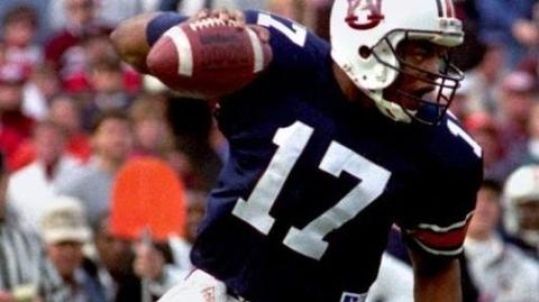
Auburn quarterback Reggie Slack completed 14 of 26 passes for 276 yards.

The Tide stopped the Auburn offense on its next possession to force a punt and get the ball back at their 32-yard-line when Hollingsworth continued his hot streak by completing six straight passes to led Bama to the Auburn 18-yard-line where they had 2nd-and-1.
But after Turner was stopped for no gain on 2nd down and Hollingsworth threw his first incompletion after 12 straight completions on 3rd down, the Tide were faced with a do-or-die 4th-and-1.
The Tide would convert as Martin Houston ran for 7 yards to give Bama a 1st down at the Tigers’ 11-yard-line.
However, the Tide only gained four yards on the next three plays and needing a field goal to have any chance of tying or winning the game, Curry sent the field goal unit onto the field.
Doyle drilled the 23-yarder to cut the lead to 27-20 with 1:49 left in regulation to make the Auburn faithful nervous as they knew an onside kick was coming up on the ensuing kickoff.
However, backup quarterback Frank McIntosh recovered the onside kick for Auburn and after six straight runs for 30 yards that forced Bama to burn their three timeouts, Lyle came on to kick a 34-yard field goal that clinched the 30-20 victory for the Tigers and a share of the SEC title.
Despite the loss, the Tide were still invited to play in the Sugar Bowl where they lost 33-25 to the Miami Hurricanes, which led to a contract offer from the University of Alabama to extend Curry but did not include a raise and take away his power to decide who would be on his coaching staff.
Curry was so insulted by the offer that he left Tuscaloosa and became the head coach for the University of Kentucky.
On the other hand, Auburn would defeat Ohio State 31-14 in the Hall of Fame Bowl in Tampa to give the Tigers their fourth straight 10-win season and #6 final ranking.
The 1989 win was the last time Dye led Auburn to a victory over the hated Crimson Tide as he would lose the next three meetings in Birmingham before resigning after the 1992 season.

The “Iron Bowl” returned to Auburn in 1993 and alternated with Birmingham until 2000 when the Tide moved their portion of the home-and-home back to Tuscaloosa, making the rivalry a true home-and-home series
Auburn fans celebrate after the Tigers knocked off the Crimson Tide 30-20,ending Alabama's chances of an undefeated season.

NFL Old School Game of the Week: Lions Defeat Vikings in Thanksgiving Shootout

Scott Mitchell then for a then Thanksgiving Day record 410 yards and four touchdown passes in the Lions' 44-38 win.
Ever since 1934, the Detroit Lions have played on Thanksgiving Day, with the exception of the years 1940-1944.
One of their more memorable Thanksgiving Day contests occurred in 1995 when they hosted their division rivals, the Minnesota Vikings.
The Lions entered the game 5-6, having won their previous two games after starting the season 0-3 and 3-6.
The Lions were led by head coach Wayne Fontes, who was in his seventh full season at the helm in Detroit and along with all-Pro running back Barry Sanders, had helped the Lions to three playoff berths in the previous four seasons, including a trip to the NFC Championship Game in 1991.
But if the Lions were going to be able to make a run for another run to the playoffs, they would have to rely on their quarterback Scott Mitchell, their much-maligned free agent signing before the 1994 season after Mitchell had filled in amicably for the Miami Dolphins when a torn Achilles tendon ended Dan Marino’s season in 1993.
Mitchell struggled in his first season in Detroit as he only threw for 1,456 yards, 10 touchdowns, and 11 interceptions as he was eventually benched in favor of veteran Dave Krieg, who along with Sanders, who finished the season with 1,883 rushing yards, got the Lions to the playoffs only to be knocked out by the Green Bay Packers in the Wild Card Round 16-12 when Sanders was held to -1 yard rushing.
The Lions’ opponent, the Minnesota Vikings, were also in the thick of the playoff race as they held a 6-5 record and were hoping to make it to the playoffs for the fourth straight year under head coach Dennis Green.
The Vikings had no issues with their quarterback as they were led by Warren Moon, who had just celebrated his 39th birthday the previous Saturday, and all-Pro wide receiver Cris Carter, who had set the NFL record for most receptions in a season with 122 catches.
The Lions received the opening kickoff and drove 68 yards in 12 plays for the game’s first touchdown, as Mitchell completed six of seven passes for 71 yards with four of those passes going to Brett Perriman for 45 yards, including the two-yard touchdown that put Detroit up 7-0, 6:46 into the game.
After forcing the Vikings to go three-and-out on their opening possession, the Lions appeared be on their way to another score as they drove from their 41-yard-line to the Minnesota 35-yard-line until Mitchell was picked off by Vikings free safety Orlando Thomas, giving Minnesota the ball at their 20-yard-line.
However, the Vikings would give the ball right back to the Lions four plays later when Moon was sacked by the Lions’ Antonio London, causing a fumble that was recovered by defensive tackle Henry Thomas at the Minnesota 20-yard-line.
On the very next play, Mitchell found Perriman in the end zone for the 20-yard touchdown to increase the Detroit lead to 14-0 with 1:49 left in the opening quarter.

The Vikings would strike back on their ensuing possession as Moon connected with Reed for a 25-yard reception on the first play of the drive to put Minnesota at midfield, then after an incomplete pass and a five-yard loss by running back Amp Lee, Moon found Reed again, this time for a 55-yard touchdown, which with the extra point, cut the deficit in half, to 14-7 with 19 seconds to go in the first quarter.
The ageless Warren Moon, who had just celebrated his 39th birthday, threw for 384 yards and three touchdown passes.
The Lions responded with another 12-play touchdown drive, this one taking 77 yards and Mitchell’s primary target on the drive by Johnnie Morton as Mitchell completed eight of 10 passes for 83 yards on drive with Morton being on the receiving end on four of those completions for 53 yards, including the 16-yard touchdown to push the Detroit lead back to two touchdowns at 21-7 with 10:03 left in the first half.
The Vikings would quickly get back into scoring position as Qadry Ismail returned the ensuing kickoff 45 yards to the Lions’ 45-yard-line and a few plays later Minnesota had a 3rd-and-1 at the Detroit 19-yard-line, only to have fullback Charles Evans be dropped for a one-yard loss, forcing a 38-yard field goal attempt by Fuad Reveiz, which he missed keeping the Vikings down 21-7.
Despite the missed field goal, it would be the Vikings special teams that would get Minnesota their next two touchdowns.
The first one came courtesy of David Palmer, who returned the ensuing punt by the Lions, 74 yards for the touchdown to make it 21-14.
Then on the ensuing kickoff, Ron Rivers lost the football which was recovered by Orlando Thomas, who returned the fumble 17 yards for the Vikings’ shocking second touchdown in 14 seconds, which with Reveiz’s extra point tied the game at 21 with over six minutes to go before halftime.
The Lions would respond to Minnesota’s two special teams touchdowns in 14 seconds by driving from their 24-yard-line to the Vikings’ 13-yard-line, thanks to the left arm of Mitchell as he completed three passes for 54 yards.
But the drive would stall as Mitchell threw three straight incomplete passes and the Lions had to settle for a 32-yard field goal by Jason Hanson which put the Lions back on top, 24-21 with 2:13 left in the first half.
However, that was just enough time for the Vikings to get another score as they drove 76 yards in eight plays, with a key play being a 45-yard pass from Moon to Reed on 2nd-and-17 at the Minnesota 43-yard-line, with the drive ending on a 10-yard touchdown pass from Moon to Carter to give the Vikings their first lead of the game at 28-24 as the first half come to a close.
The track meet looked to continue in the second half as the Vikings took the ball to start the half and drove 51 yards in 12 plays, as the drive ended on a 49-yard field goal by Reveiz to increase the Minnesota lead to 31-24.
The Lions would respond once again with another scoring drive, but this one led by the legs of Sanders, who had been held in check in the first half as he gained only one yard on 10 carries.
Sanders would carry the ball four times for 23 yards on an eight-play, 54-yard drive that culminated with a 40-yard field goal by Hanson to cut the Vikings’ lead to 31-27 with over five minutes to go in the third quarter.
After a holding penalty on the kickoff pushed them to start their next drive at their eight-yard-line, the Vikings would drive 27 yards until Moon was intercepted on a pass intended for Carter by cornerback Corey Redmond, whose 15-yard return plus 15-yard penalty on Carter for grabbing Redmond’s face mask put Detroit at the Minnesota 27-yard-line.
And just like in the first quarter where it only took the Lions one play to get in the end zone after a Viking turnover, Mitchell connected with Herman Moore for the 27-yard touchdown on the first play after the interception to put the Lions back in the lead, 34-31 with 3:47 left in the third quarter.
(From left to right) Herman Moore, Brett Perriman, and Johnnie Morton all had over 100 yards receiving and one touchdown reception(Perriman had 2).
The score was still 34-31 as the game entered the fourth quarter, but it could have been 38-34 in favor of the Vikings if not for a holding penalty on Minnesota’s Pete Bercich which negated a 55-yard punt return touchdown by Palmer toward the end of the third quarter.
However, the Lions were still in front when t drove from their 33-yard-line to the Vikings’ 18-yard-line, thanks to three receptions by Perriman for 38 yards when Mitchell connected with Perriman again for a 18-yard touchdown, only to have Moore be called for offensive pass interference, negating the touchdown and pushing Detroit back 10 yards to the Minnesota 28.
Detroit would gain six more yards to set up a 40-yard field goal by Hanson, but he missed, keeping the score at 34-31.
However, the Detroit defense would force the Vikings to punt for the third straight time, giving the Lions the ball back, but at their seven-yard-line.
After a 21-yard pass to Moore, Mitchell handed off to Sanders, who for the first time in the game broke off a long run, as he busted open for a 53-yard run.
But towards the end of the run, Minnesota cornerback Corey Fuller came in from behind and stripped the ball out of Sanders’ hands, which was recovered by Orlando Thomas for his third fumble recovery of the day, giving the Vikings the ball back at their own 20-yard-line.
But for the fourth straight time, the Vikings were forced to punt as they would go three-and-out, giving the Lions the ball back at exactly the 50-yard-line.
After an incomplete pass to Perriman on 1st down, Mitchell handed the ball off to Sanders, who once again bust through the line and down the right sideline, this time hanging on to the ball for a 50-yard touchdown to increased the Lions’ lead to 41-31 with 5:18 to go in the game.
Needing two scores, the Vikings went almost exclusively to the air on their ensuing possession, as Moon completed six of seven passes for 55 yards on a eight-play, 65-yard drive which culminated with a seven-yard touchdown pass from Moon to Carter which cut the Lions’ lead to three points, 41-38 with 2:06 to go.
Even though the Vikings had two timeouts left and the two-minute warning, Green decide to go for the onside kick, which was recovered by Herman Moore at the Vikings’ 46-yard-line.
After Sanders was stopped for no gain on 1st down, the Lions gambled and attempted to pass on 2nd down.
The gamble paid off as Mitchell connected with Moore for 29 yards, as he joined Perriman and Morton as 100-yard receivers in the game for the Lions, and a Detroit 1st down at the Minnesota 17-yard-line.
Sanders would get the ball on the next three plays but ended losing four yards as Detroit faced a 4th-and-14 with about 40 seconds to go.
Fontes could have gambled and attempted to go for the 1st down, which if successful would have automatically sealed the win for the Lions as Minnesota had used up their timeouts, but instead called on Hanson to try a 39-yard field goal to push the lead to six points.
Hanson’s kick was true and the Lions had a 44-38 lead with 35 seconds left, but still giving the Vikings one last chance.
Moon hit three passes for 45 yards to get the Vikings to the Lions’ 38-yard-line for one last shot at a Hail Mary to steal the win.
103 of Barry Sanders' 138 yards came on two runs in the 4th quarter.
But Moon’s Hail Mary attempt would be picked off by Detroit’s Sean Vanhorse sealing the 44-38 victory for the Lions and ending a wild game that saw both teams combined for 82 points, making it the second-highest scoring game on Thanksgiving Day, and a combined 919 yards of offense with 746 of them coming through the air.
The Vikings would win their next two games, but drop their final two games, ending the season with a 8-8 record and marking the first time in the Dennis Green era that the time the missed the playoffs.
Meanwhile, the Lions rode their high-powered offense to four more wins as they ended the regular season on a seven-game winning streak to finish with a 10-6 record and earned their third straight playoff berth and fourth in five years, thanks to Mitchell’s 4,338 passing yards and Moore’s 123 receptions, which broke Carter’s record he set the previous season(Ironically, Carter would once again would finish the season with 122 receptions).
But in the Wild Card Game against the Philadelphia Eagles, Mitchell self-destructed as he threw four interceptions and was replaced by Don Majkowski(the man who Brett Favre replaced in Green Bay to begin his legendary career) as the Lions fell to Philadelphia 58-37.
Mitchell remained with the Lions for three more seasons and helped Detroit to another playoff berth in 1997, though that was primarily because of Sanders’ 2, 053 rushing yards that season, before he lost his starting job to Charlie Batch during the 1998 season, which was his last one in Detroit.
Mitchell played with the Baltimore Ravens for the 1999 season and then with the Cincinnati Bengals for the 2000 and 2001 seasons before ultimately hanging up his cleats after 11 NFL seasons in which he threw for a career 15, 692 yards and 95 touchdown passes.

NFL Old School Game of the Week: White Shoes Catches Hail Mary TD For Falcons

Billy Johnson(81) stretches for the goal line to complete the 47-yard game-winning touchdown as time expires.
The Atlanta Falcons do not have the prestigious history of the San Francisco 49ers as the Falcons have recorded only 16 winning seasons and have never won a Super Bowl in their nearly half-of-century existence while the 49ers have won five Super Bowls.
But what the Falcons do have a great history of winning games with the “Hail Mary” or “Big Ben” which has happened on three occasions.
The first occurred in 1978 when Steve Bartkowski threw a pass down the right sideline that was tipped in the air by Wallace Francis and caught by Alfred Jenkins for a 57-yard touchdown with five seconds left to give the Falcons a 20-17 win against the New Orleans Saints and helped the Falcons get into the playoffs for the first time in team history.
Five years later, “Big Ben” would strike again for the Falcons against the 49ers on November 20, 1983.
The Falcons entered the 1983 season with a new head coach, Dan Henning, who replaced Leeman Bennett despite the fact that Bennett had led the Falcons to the postseason three times in five years.
Henning’s first year was not going so well as the Falcons entered their meeting with the 49ers with a 4-7 record.
One of the few bright spots for the Falcons was the reemergence of Billy “White Shoes Johnson” , who after a knee injury in 1978 hampered his play for several seasons and forced to to play the 1981 season in the Canadian Football League, had been become the Falcons’ leading receiver and had returned a punt for a touchdown for the sixth time in his career.
If the Falcons were to beat the 49ers, Johnson would need to have a big day.
The 49ers entered the 1983 season hoping to get back to the playoffs after failing to reach the playoffs in 1982 following their Super Bowl title.
In the offseason, head coach Bill Walsh tried to upgrade the team’s running game, which finished dead last in 1982 by drafting Roger Craig and acquiring Wendell Tyler in a trade.
Still, the 49ers’ fortunes rested on the right arm of quarterback Joe Montana, who would gone to throw for nearly 4,000 yards during the 1983 season.
The 49ers entered their game with the Falcons with a 7-4 record, but needing a win as they in a hotly contested race for the NFC West title with the Los Angeles Rams.
The 49ers got the ball to start the game at their own 19-yard-line and drove to their 44-yard-line when Montana hit running back Earl Cooper for an apparent 1st down on 3rd-and-1, only to have Cooper fumbled the ball when he was hit by Falcons strong safety Tom Pridemore.
Cornerback Bobby Butler recovered the fumble for the Falcons at their own 40-yard-line, where Atlanta took over and drove to the 49ers’ 36-yard-line, where the drive stalled.
Mick Luckhurst come on to attempt a 53-yard-field goal, but his kick was short, giving the 49ers the ball at the 36-yard-line.
That is when Montana and the 49ers drove 64 yards in 11 plays, culminating with a six-yard touchdown run by Craig that put San Francisco ahead 7-0 with 1:30 left in the opening quarter.

The Falcons took over at their nine-yard-line, but lost six yard on three plays forcing Atlanta to punt, which was blocked by safety Ronnie Lott, giving San Francisco the ball at the Atlanta eight-yard-line.
Floyd Hodge(83)who had seven catches for 68 yards, tries to break from the 49ers' Ronnie Lott.

Two plays later, the 49ers were back in the end zone as Montana found Tyler for a eight-yard touchdown on the first play of the second quarter to increase the 49er lead to 14-0.
After Tyler’s touchdown, the Falcons took over at their 17-yard-line when Bartkowski went to work as he went 7-of-8 for 75 yards on a 11-play, 83-yard drive that ended when Bartkowski found Stacey Bailey for a 18-yard touchdown that cut the 49er lead in half, 14-7 with 6:30 left before halftime.
The Falcons would force the 49ers to punt on their next possession to get the ball back at their 10-yard-line and drove to the San Francisco’ 43-yard-line where they faced a 4th-and-6 with just over a minute to go in the first half.
Henning decided to gamble and go for the 1st down as Bartkowski completed a pass to Johnson, who came up a yard short as he was stopped by Lott, giving the 49ers the ball at their 38 with 1:02 left in the half and a chance to get into field goal range.
Montana got the 49ers to the Falcons’ 44 when he faced a 3rd-and-4, needing one more completion in order to give his kicker, Ray Wersching, a shot at a field goal.
Montana dropped back and found Renaldo Nehemiah for a gain of six yards to get the apparent 1st down.
But Nehemiah was met by Falcons cornerback Kenny Johnson, who clobbered the 49ers receiver, knocking Nehemiah out cold.
As Johnson tried to see if Nehemiah, there was a mad scramble behind him as Johnson’s hit had knocked the ball loose after Nehemiah made the catch.
The Falcons’ Blane Gaison picked up the ball and raced 64 yards for the touchdown that along with Luckhurst’s extra point tied the game at 14 with nine seconds left in the half.
Renaldo Nehemiah falls to the ground after being hit by Falcons cornerback Kenny Johnson(37).
The 49ers got the ball back but ran out the final seconds to go into halftime tied at 14, but with momentum on the side of the Falcons thanks to the defensive touchdown and the fact the Falcons would get the ball to start the second half.
The Falcons got the ball at their own 20 and drove to the 49ers’ 39-yard-line only to have drive stall and force Atlanta to punt the ball back to San Francisco, who took over at its 16-yard-line.
The 49ers put together a 12-play, 77-yard drive that included a pair of 15-yard passes by Montana; one to Craig, the other to Mike Wilson, plus a 15-yard roughing the passer penalty that was called on Atlanta defensive end Jeff Morrow.
However, the Falcons held the 49ers out of the end zone and forced San Francisco to settle for a 25-yard field goal by Wersching that broke the tie and put the 49ers back on top 17-14 with 2:07 left in the third quarter.
Atlanta took over on its 20 and drove to the 49ers ‘40-yard-line where they faced a 4th-and-1.
Henning again decided to go for it as both teams lined up in their respective goal line formations.
Bartkowski took the snap and handed it off to Gerald Riggs, who busted through the line and scampered for the 40-yard touchdown that gave Atlanta its first lead of the game at 21-17 with 13:22 remaining in the game.
Following Riggs’ touchdown, both teams traded punts until the 49ers got the ball at their own 49-yard-line with 2:56 left and a chance to retake the lead.
On the first play of the drive, Montana connected with Wilson for 19 yards to put San Francisco at the Atlanta 32-yard-line.
After an incomplete pass and a four-yard run by Tyler, Montana hit Bill Ring for six yards on 3rd-and-6 to give San Francisco a 1st down at the 22.
Then, Montana ran for six yards and then got linebacker Buddy Curry to jump offsides to give the 49ers another 1st down at the 11.
That is when Montana dropped back to pass but then tucked the ball in and ran in the final 11 yards for the touchdown that put the 49ers back on top 24-21 with just 1:10 to play.
Joe Montana drove the 49ers 51 yards in six plays to score what was thought to be the game-winning touchdown with 1:10 left.
Riggs returned the ensuing kickoff 19 yards to the Falcons’ 23-yard-line giving Bartkowski 64 seconds to get into field goal range and give Luckhurst a chance to tie the game and send to overtime.
The drive started with a 10-yard pass from Bartkowski to Riggs, followed by two incomplete passes, leading to a 3rd-and-10.
That is when Bartkowski found Johnson for 17 yards to put the Falcons right at the 50-yard-line.
But after a three-yard pass to tight end Junior Miller and another incomplete pass, the Falcons were at the 49ers’ 47 yard-line with two seconds remaining and well out of field goal range.
Atlanta had no chance to but to go for their “Hail Mary” which they called “Rocket Left”, which had Johnson, Bailey, and Floyd Hodge all line up on the left side and ran downfield with the intention of one of the receivers tipping the ball so one of the other receivers can make the catch.
Bartkowski took the snap, dropped back, and launched a pass as far as he could throw, which came down around the five-yard-line.
As the three receivers ran down the field, Johnson slipped on the wet grass and fell down around the five as the ball descended into a crowd of 49er defenders, only to have Bailey get his hand in through the crowd to tip the ball back to Johnson.
Johnson made the catch, then circled to his right to get around the 49er defenders, until he was hit at the two-yard-line by the 49ers’ Eric Wright, causing him to fall down again.
But as he was falling, Johnson stretched the ball with his right arm to cross the plane to get the touchdown.
After Johnson was down, the referees huddled for several seconds to discuss what they had saw, though the 49ers tried to convince the officials that Johnson’s knee had hit the ground before he crossed the plane.
Finally, the referees raised their arms and signaled touchdown, and the Falcons had come away with a shocking 28-24 victory(Luckhurst had to kick the extra point).

The Falcons would pull off another amazing victory the following week as they came back from a 21-point deficit for the second time in the 1983 season to win a game as they defeated the Green Bay Packers 47-41 in overtime.
However, Atlanta would finish the season 7-9 while the 49ers would win their final three games to finish the season with a 10-6 record and clinch the NFC West.
San Francisco would defeat the Detroit Lions 24-23 in the Divisional Playoffs, before falling to the Washington Redskins 24-21 in the NFC Championship Game.
For the next several years, the 49ers would dominate the rivalry with the Falcons as they went 12-1-1 over the next 14 meetings until 1991 when the Falcons swept the season series, that included a 17-14 victory as Michael Haynes caught a Hail Mary pass from quarterback Billy Joe Tolliver with one second to go in the game for “Big Ben III”.
As for Johnson, he would finish the year as the NFL Comeback Player of the Year thanks to his 64 catches and 709 yards with his four touchdowns to go along with 489 punt return yards which was 2nd most in the NFL.
However, another knee injury would keep out for most of the 1984 season before he returned in 1985 to be the Falcons’ leading receiver that year.
He retired after the 1988 season as the all-time punt returner in yards with 3,317(he now sits 7th) and six touchdowns to go along with his 2,902 kickoff return yards and two touchdowns.
In 1994, Johnson was named to the NFL’s 75th Anniversary Team as the punt returner but yet remains the only member of that team not in the Hall of Fame.


Wednesday, November 15, 2017

NFL Old School Game of the Week: Controversial Penalty Allows Raiders To Beat Patriots

Ken Stabler dives for the game-winning touchdown with 10 seconds left to give the Raiders a 24-21 win over the Patriots in their 1976 AFC Divisional Playoff.
When NFL fans think about the Oakland Raiders and the New England Patriots and playoff controversy, they think about the infamous "Tuck Rule" that allowed a Tom Brady fumble to be overturned into an incomplete pass, allowing for the Patriots to defeat the Raiders in the 2001 NFL Playoffs.
However, that was not the first time that the Raiders and the Patriots were embroiled in a controversial call that helped determine a NFL playoff game.
25 years earlier on December 18, 1976, the Raiders hosted the Patriots in the Divisional Playoffs.
For the Raiders, this was their 10th straight trip to the playoffs, eight under head coach John Madden, but Oakland had made it to the Super Bowl only time in 1967 and had lost in six conference championship games, including the previous three with the last two coming courtesy of the Pittsburgh Steelers.
Even though they were the #1 seed in the AFC with a 13-1 record entering their game with New England, there was an enormous amount of pressure on Madden, quarterback Ken Stabler, and the rest of the Raiders to get the job done and finally win a Super Bowl.
While the Raiders were no strangers to the playoffs, the New England Patriots were making their postseason appearance since they played for the 1963 AFL Championship.
Led by head coach Chuck Fairbanks and second-year quarterback Steve Grogan, the Patriots had gone from 3-11 the previous season to 11-3 in the 1976 season to earn the AFC's Wild Card berth and a trip to Oakland.
Even many of their players had never played a playoff game and they entered as a touchdown underdog, the Patriots had to feel confident because they were the team that handed the Raiders their only loss of the 1976 season, a 48-17 shackling in Foxboro.
Plus, New England felt they were playing with house money as they were the "Cinderella" team and were note excepted to go far while the Raiders were excepted to finally exorcise their playoff demons.
After both teams punted on their opening possessions, the Patriots took over at their 14-yard-line and proceeded down the length of the field on the right arm of  Grogan as he completed all four of his passes for 78 yards on the 10-play drive which included a 41-yard reception by tight end Russ Francis and then a 24-yard pass to Daryl Stingley that gave New England a 1st-and-goal at the one-yard-line where Andy Johnson punched it for the game's first touchdown, giving the Patriots a 7-0 lead.
Andy Johnson(32) and Sam Cunningham(39) combined for 100 yards on 34 carries and scored one touchdown.


Following the ensuing kickoff, the Raiders took over at their 32-yard-line, but it only took them one play to drive into Patriots territory as Stabler hit Fred Bilentikoff for 22 yards to give Oakland a 1st down at the New England 46-yard-line.
Then, Stabler found Cliff Branch for 18 more yards to give the Raiders another 1st down at the New England 25-yard-line.
However, the Raiders would only pick up two more yards and were forced to settle for a 40-yard field goal by Errol Mann that cut the Patriots lead to 7-3 with 1:13 left in the opening quarter.
The score was still 7-3 in the second quarter the Raiders were given an excellent scoring opportunity after running back Sam Cunningham fumbled the football, which was recovered by Oakland linebacker Willie Hall inside the Patriots' 20-yard-line.
But the Raiders gave the ball right back to the Patriots two plays later when running back Clarence Davis fumbled the football, leading to a recovery by New England defensive end Mel Lunsford at the Patriots' 11-yard-line.
New England proceeded to drive deep into Raiders territory, even converting a 4th-and-inches at the Oakland 43-yard-line as running back Don Calhoun picked up seven yards on the 4th down play.
Then the Patriots tried to pull a rabbit out of their hat as they called an end-around reverse for Francis who was going to throw it, instead of run it.
The trick play backfired as Francis was intercepted by Raiders cornerback Skip Thomas, who made the pick at his own six-yard-line and then returned it 18 yards, to give Oakland the ball at their 24-yard-line with 2:27 left in the first half.
A 13-yard pass to Bilentikoff and a a 18-yard pass to Casper help lead to a spectacular one-handed catch by Bilentikoff for a 31-yard touchdown to give the Raiders a 10-7 lead with 39 seconds left in the half(click to play).

The Patriots would run out the clock and go into the locker room trailing by just a field goal.
The Raiders punted following their opening drive of the second half and it looked like the Patriots were going to punt as well on their opening drive as they punted the ball from their 22-yard-line, only to have Thomas be called for a holding penalty, to give New England a 1st down at the Raiders' 32-yard-line.
On the next play from scrimmage, the Patriots were in Raiders territory as Cunningham busted through the middle for a 22-yard run to the Oakland 46-yard-line.
Then, Francis took over as he made a 20-yard catch and then on 3rd down from the Raiders 26-yard-line, Francis caught Grogan's strike over the middle at the 15-yard-line and then outran the Oakland defense for the go-ahead touchdown to give the Patriots a 14-10 lead with 6:46 left in the third quarter.
Things did not get better for the Raiders as they went three-and-out on their next offensive possession, giving the Patriots the ball back at their 45-yard-line, who were able to drive to the Oakland 20-yard-line, thanks in large part to three Raider penalties, which included Oakland linebacker Ted Hendricks jumping offsides on a New England punt.
From the Raiders' 20, New England ran the ball five straight times, with Jess Phillips getting the call on the last run, which happened to be a three-yard touchdown to increase the New England lead to 21-10 with 1:23 left in the third quarter.
Oakland fans grew nervous as their beloved Raiders were staring down at another disappointing playoff loss as they needed two touchdowns in the final 16 1/2  minutes to win.
The Raiders would respond with a 11-play, 70-yard drive as Stabler completed all five of his passes on the drive for 53 yards, with three of those completions going to Bilentikoff totaling 38 yards.
The drive was capped off by a one-yard touchdown run by Mark van Eeghen to cut the Patriots lead to 21-17 with 11:03 left in the fourth quarter.
Following an exchange of punts, the Patriots drove to the Raiders' 28-yard-line where they faced a 3rd-and-1 with 4:30 left in the game.
One more 1st down wouldn't put the game away, but it would go a long way in paving the way for the Patriots to pull off the upset.
But New England jumped before the snap drawing a five-yard penalty and making it 3rd-and-6, instead of 3rd-and-1.
That is when Grogan dropped back and threw a pass intended for Francis that the tight end failed to catch because he was held by Raiders linebacker Phil Villapiano.
However, no penalty was called on the Raiders and the Patriots were forced to call on John Smith to attempt a 50-yard field goal to extend the lead to a touchdown.
But Smith's kick was short and the Raiders took over at their 32-yard-line with 4:12 left in the game.
Fred Bilentikoff makes one of his nine catches for 137 yards and a touchdown in the Raiders' 1976 Divisional Playoff with the Patriots


Back-to-back completions to Bilentikoff for seven yards and Branch for eight yards had the Raiders at their 47-yard-line, which was followed by a one-yard run, and then a 12-yard reception by Bilentikoff that put the Raiders in New England territory at the Patriots' 41-yard-line.
Then, Stabler hit Casper for 21 yards to give the Raiders a 1st-and-10 at the Patriots' 20-yard-line with over two minutes left.
Following Casper's catch, the Patriots defense came to life as they forced an incomplete pass and a quarterback sack by Lunsford pushed Oakland back to the 28-yard-line where they faced a 3rd-and-18 when the controversial moment arrived.
On the play, Stabler took the snap, dropped back, and fired a pass intended for Carl Garrett that fell incomplete, only to have referee Ben Drieth called Patriots nose tackle Ray "Sugar Bear" Hamilton get called for roughing the passer, giving Oakland a 1st down at the Patriots' 13-yard-line.
Though Sugar Bear did hit Stabler in the helmet, which probably would have been roughing the passer in today's NFL, he seemed to arrived just a microsecond after Stabler lofted the duck for Garrett, to which Patriots players and coaches cried out that no roughing the passer should be called.
Nevertheless, the call was made and instead of facing 4th-and-18 at the 28-yard-line, Oakland had 1st-and-10 at the 13-yard-line with 57 seconds to go(click to play).

On the very next play, Stabler hit Casper for five yards, who promptly got out-of-bounds to stop the clock, which was followed by a four-yard run by Davis setting up 3rd-and-1 from the four-yard-line with 40 seconds left.
That is when Pete Banaszak got the ball and got the one yard needed for the first down, plus an extra yard-and-half when Patriots strong safety Prentice McCray was called for unsportsmanlike conduct and giving the Raiders 1st-and-goal from the one-and-half yard-line when they called timeout.
After the timeout, Stabler handed the ball off to Banaszak who was stopped for no gain, leading to a 2nd-and-goal.
That is when Stabler called for a run-pass option where the "Snake" would roll to the left side and either loft a pass for Casper in the end zone or try to run it in himself.
With 14 seconds to go, Stabler took the snap, rolled left, and decided to dive for the touchdown which he got to put Oakland ahead 24-21 with 10 seconds left(click to play).

The Patriots could do nothing in the final 10 seconds as they lost 24-21, ending their Cinderella season.
New England would go 9-5 the following season but would miss out on the playoffs, which was followed by their first division title since 1963 as the Patriots won the 1978 AFC East title.
However, chaos ensued before the Patriots' regular season finale as Fairbanks was suspended by Patriots ownership for negotiating with the University of Colorado on becoming its head coach.
Fairbanks returned for the playoffs but he had lost the locker room as New England showed a poor effort in the Divisional Playoffs as they were beaten at home by the Houston Oilers 31-14.
Fairbanks would leave to take the job at Colorado following the loss to the Oilers.
As for the Raiders, they carried the momentum from their comeback win over to the Patriots all the way to their first Super Bowl title as they defeated the two-time defending Super Bowl Champion Pittsburgh Steelers 24-7 in the AFC Championship and then knocked off the Minnesota Vikings 32-14 in Super Bowl XI.
The Raiders would return to the playoffs the following year were they were eliminated in the AFC Championship Game by their AFC West division rival, the Denver Broncos.
After the Raiders went 9-7 in 1978 but missed the playoffs for the first time since 1966, Madden resigned as head coach of the Raiders and was replaced by offensive coordinator Tom Flores who lead Oakland to a 9-7 season in 1979, which was the final year with Stabler as the Raiders starting quarterback as he was traded to the Houston Oilers for their starting quarterback, Dan Pasteroni.
However, it would be Jim Plunkett, who would come off the bench and lead the Raiders to two more Super Bowl titles in the next four years, while Stabler played two seasons in Houston, then three more with the New Orleans Saints, until his retirement after 15 NFL seasons.
Though the two teams played in the 1985 NFL playoffs with the Patriots upsetting the Raiders 27-20 in the Divisional Round, it would not be until the 2001 playoffs when once again the two teams were at the center of a controversial call in a playoff game, though this one went in the Patriots' favor and help kickstart their run of five Super Bowl championships in 16 years.
In New England Patriots fans' minds, the "Tuck Rule" was the football gods returning the favor for the Sugar Bear Hamilton penalty.