Thursday, September 20, 2018

College Football Old School Game of the Week: Pupil Defeats Teacher as A&M Stuns Bama in Cotton Bowl

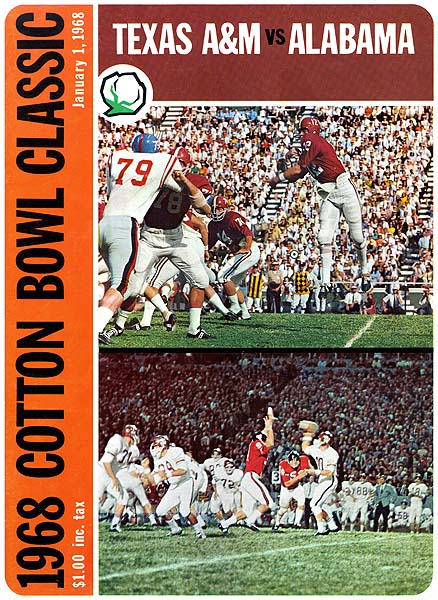
Student met teacher in the 1968 Cotton Bowl as 32-year-old Gene Stallings took his Texas A&M Aggies to face Alabama and his former boss, legendary head coach Paul "Bear" Bryant.
Stallings was a wide receiver for Bryant when the Bear was the head coach at Texas A&M, helping the Aggies win their Southwest Conference championship in 17 years when A&M went 9-0-1 during the 1956 season.
Following the 1957 season, Bryant left College Station to become the head coach at the University of Alabama, where Stallings joined him as a assistant coach for the defense.
With Stallings by his side, Bryant led the Tide to two national championships in 1961 and 1964, before Stallings returned to his alma mater to become the Aggies' head coach.
While Stallings and the Aggies struggled in his first two years in College Station, going a combined 7-12-1, Brynat led Bama to another national championship in 1965 and an undefeated season in 1966.
It appeared the 1967 season was going to be another long one for Stallings and the Aggies as they dropped their first four games to start the season 0-4.
But Stallings lead a dramatic turnaround as A&M won their last six games, including a 10-7 win over Texas to clinch the Southwest Conference title and earn a trip to the Cotton Bowl.
However, they went enter the game as heavy underdogs as they prepared to face the #8 ranked Crimson Tide, who coming off what was considered a down year as they finished the regular season 8-1-1.
With future NFL Hall-of-Famer Ken Stabler at quarterback and All-American Dennis Homan at wideout, the Tide were excepted to cruise over the Aggies.
But on a cold, muddy day in Dallas, the Crimson Tide would have to fight off a tough Texas A&M team.
Texas A&M quarterback Edd Hartnett(10) completed 11 of 21 passes for 143 yards with two touchdowns and zero interceptions.

Alabama got the ball to start the game as they begin their first possession at their 35-yard-line.
But a miscommunication but Stabler and the backfield led to the quarterback pitching to no one, which was picked up A&M defensive tackle Ron Krueger at the Tide 28-yard-line.
Three plays netted eight yards for the Aggies leading to a 4th & 2 situation where Stallings decided to go for the 1st down.
The gamble did not pay off as Alabama linebacker Bob Childs knocked down A&M quarterback Edd Hartnett's pass forcing a turnover on downs and giving the ball back to the Crimson Tide at their 20-yard-line.
From there, the Alabama offense was able to put together the first good drive of the game, thanks to a 30-yard pass from Stabler to Homan and a 14-yard run by fullback David Chatwood, leading to a 4th & 2 at the Aggies' 10-yard-line.
That is when Bryant decided to gamble and go for the 1st down which he got when the Aggies jumped offsides, drawing a five-yard penalty and giving the Tide a 1st & goal at the five-yard-line.
One play after a two-yard run by Chatwood, Stabler would run around the left side  for a three-yard touchdown to give Bama a 7-0 lead with 8:22 left in the first quarter.
After forcing the Aggies to punt on their next possession, the Crimson Tide got the ball at their 29-yard-line, only to give it right back to A&M on the first play of the drive when Stabler overthrew a pass intended for tight end Hunter Husband and landed in the hands of safety Tommy Maxwell for an interception, giving A&M the ball at the Tide 43-yard-line.
Perhaps discombobulated from the interception, the Tide defense lined up with only 10 men on the field on the first play of the drive as Hartnett fired a 28-yard pass to Barney Harris gave A&M a 1st down at the Bama 15-yard-line.
Then on 3rd & 8 from the 13, Hartnett threw a pass to running back to Larry Stegent, who made the catch at the five-yard-line, then broke the tackle of Alabama defensive back Bobby Johns to go run into the end zone for a 13-yard touchdown that tied the game with 5:22 remaining in the opening quarter.
The Tide came back with a 11-play, 56-yard drive that culminated with a 36-yard field goal by Steve Davis on the first play of the second quarter to give Alabama a 10-7 lead.
The game would turn into a defenisve stalemate for the majority of the second quarter as both teams combined for only 1st down until the Aggies defense forced their second turnover of the game when Jim Piper recovered a fumble following a hit on Bama wide receiver Perry Willis, giving A&M the ball at their 44-yard-line in the final minutes of the first half.
The Tide defense would poised to force a three-and-out but Hartnett hit Bob Long for a 17-yard gain on 3rd & 10 to give the Aggies a 1st down at the Bama 39-yard-line.
On the next play, Hartnett connected with tight end Tom Buckman for 21 yards, to put the Aggies in scoring position at the Tide 18-yard-line with 1:18 left before halftime.
Two plays later, the Aggies were faced with another 3rd down, this time 3rd & 13 from the 21-yard-line, when Hartnett threw a pass to Stegent in the right flat as the running back made a juggling catch for a 14-yard gain to set up 1st & goal with 21 seconds left.
That is when Hartnett hit Maxwell(that same Tommy Maxwell who made the game's first interception) for a seven-yard touchdown to give the Aggies their first lead of the game.
Though Charlie Riggs would miss the extra point, the Aggies went into the locker room with a 13-10 lead over the heavily-favored Crimson Tide.
While he ran for two touchdowns, Alabama quarterback Ken Stabler would threw three interceptions in the Tide's shocking loss to Texas A&M.

After both teams punted on their opening possessions of the second half, the Aggies would drive 52 yards in six plays as Wendell Housely slipped by five Alabama defenders on his way to a 20-yard touchdown to push the A&M lead to 20-10 midway through the third quarter.
The Tide would toake over at their 17-yard-line but quickly drove down the field as Chatwood ran for 20 yards to start the drive, which was followed by a 19-yard pass to future Clemson and Arkansas head coach Danny Ford to the Aggies' 40-yard-line, and then a 22-yard pass from Stabler to Homan to give Bama a 1st-and-goal at the seven-yard-line.
Stabler would run in for the touchdown to bring the Tide to within four points when Bryant decided to go for the two-point conversion.
However, the two-point attempt would fail as Chatwood would be stopped at the line of scrimmage, keeping it a four-point game at 20-16 in Texas A&M's favor with 3:55 left in the third quarter.
The score remained that way going into the 4th quarter when the Aggies drove to the Tide 22-yard-line only to have Housely fumble a handoff from Hartnett, which landed in the hands of Childs.
Childs began to run with the football only to lose the football but get saved by teammate Alvin Samples who recovered the loose ball at the 27-yard-line, to end the Aggies' threat of increasing the lead.
After another exchange of punts, Bama got the ball at their 20-yard-line with 4:02 left in the game, needing to put together a drive for a possible game-winning touchdown.
The drive got off to an auspicious start was Stabler was sacked by A&M defensive back Ivan Jones, dropping the Snake for a seven-yard-loss.
A six-yard pass to Homan would step a do-or-die 4th & 11 from the 19-yard-line where Stabler hit fullback Ed Morgan for only one yard, only to have the Tide get a reprieve when an illegal use of hands penalty was called on A&M, giving the Tide a 1st down at their 44-yard-line.
Bama would pick up 21 more yards on the next two plays as Stabler connected with Willis for seven yards, then hit Homan for 14 yards to give the Tide a 1st down at the Aggies 35-yard-line.
But Stabler would threw three straight incomplete passes, the most agonizing one being a dropped pass by Homan that would given the Tide a 1st down at the 15-yard-line, to set up another 4th down situation.
Stabler threw to Husband for six yards, but he was tackled by Maxwell, giving the ball back to A&M, who took over at their 29-yard-line with 1:16 left and a chance to run out the clock.
However, the Aggies could not get a 1st down and were forced to punt the ball back to the Tide, who got the ball at their 36-yard-line with 22 seconds left to pull off a miracle.
Hopes of that miracle were quickly squashed when A&M defensive back Curly Hallman picked off a Stabler pass and returned it 14 yards to the Tide 44-yard-line, clinching the Aggies' first Cotton Bowl in 27 years as they pulled off the 20-16 upset.
As the two coaches met to shake hands following the game, Bryant picked up Stallings in a show of respect toward his former assistant.
Texas A&M head coach Gene Stallings is hoisted by Alabama head coach Bear Bryant following A&M's shocking 20-16 win over Bama in the 1968 Cotton Bowl.

The loss in the Cotton Bowl is seen by some Alabama football historians as the start of a brief decline for the Crimson Tide as they would go 20-13-1 over the next three seasons before Bryant went to the wishbone formation for his offense and began recruiting black players to his program, which helped the Tide to nine SEC titles and three national titles over from 1971-82, the last 12 years of Bryant's tenure at Alabama.
Meanwhile, the win in the 1968 Cotton Bowl would be the highlight of Stallings' tenure as Texas A&M's head coach as he would be fired after the 1971 season compling a record of 27-45-1 in his seven seasons at College Station.
Stallings would join Dallas Cowboys head coach Tom Landry's staff in 1972 and would the team's defensive backs coach for 14 years until he became the head coach of the St. Louis Cardinals(before they moved to Arizona in 1988) for four seasons where he went 23-34-1 during that time before becoming the head coach at Alabama in 1990.
With one of the greatest defenses in college football history, Stallings would lead the Tide to their first national title in the post-Bryant era as Alabama would go 13-0 during the 1992 season, which ended with a 34-13 upset win over Miami in the Sugar Bowl.
Stallings remained as the Tide's head coach for four more years before retiring following the 1996 season.

Tuesday, September 18, 2018

NFL Old School Game of the Week: Montana Gets Revenge on 49ers

Joe Montana would get payback as he led the Chiefs to a win over his former team, the San Francisco 49ers.
When the San Francisco 49ers traveled to Arrowhead Stadium for a game with the Kansas City Chiefs during the second week of the 1994 season, they would be going a familiar face at quarterback.
Joe Montana, who had become a San Francisco legend as he helped lead the 49ers to four Super Bowl titles in the 1980s, would be the starting quarterback for the Chiefs as they prepared to face San Francisco in one of the most anticipated games of the 1994 season.
After Montana suffered an elbow injury during the 1991 preseason which ultimately sidelined him for two years, he was replaced by Steve Young, who would finish as the NFL's top rated quarterback the following two seasons and lead the 49ers to the NFC Championship Game in 1992, which they lost to the Dallas Cowboys.
By then Montana was finally healthy and wanted to compete for the starting quarterback job, but 49ers management had decided that Young should be the starter and Montana the backup.
Montana then requested for a trade which was granted just before the 1993 NFL draft as the 3-time Super Bowl MVP was traded to Kansas City, along with defensive back Dave Whitmore.
Paired with former Raiders running back Marcus Allen, Montana lead the Chiefs to their first postseason victory since they won Super Bowl IV, with a 27-24 overtime win over the Pittsburgh Steelers in the Wild Card Round, followed by a 28-20 upset of the Houston Oilers in the Divisional Round, only to fall in the AFC Championship Game to the Buffalo Bills 30-13.
With Montana and Allen back and head coach Marty Schottenheimer at the helm, the Chiefs were considered Super Bowl contenders in 1994 just like the 49ers.
Steve Young and Joe Montana greet each other before thier much-hyped showdown during the second week of the 1994 season.

While expectations were high in Kansas City, there was more pressure for Young and the 49ers as they had fallen to the Cowboys in the NFC Championship Game for the second year in a row.
With an offense which featured running back Ricky Watters, wide receiver John Taylor, and perhaps the greatest player in NFL history, wide receiver Jerry Rice, nothing short of a Super Bowl title would satisfy the 49ers' fanbase in 1994.
But first they had to get by an old friend as both the 49ers and the Chiefs won their season openers the week before, with Rice breaking the record for most touchdowns scored by a NFL player in the 49ers' 44-14 rout of the Raiders.
 The Chiefs got the ball at their 33-yard-line and were able to drive down to the 49ers' five-yard-line, thanks to a pair of 3rd down conversions as Montana hit Willie Davis for 18 yards on a 3rd & 2, then hit tight end Keith Cash for six yards on a 3rd & 5, which was followed by a 25-yard pass to J.J. Birden to give Kansas City a 1st-and-goal.
But after three plays netted four yards, the Chiefs were faced with a 4th-and-goal from the one-yard-line.
That is when the normally conservative Schottenheimer decided to gamble and go for the touchdown.
Montana took the snap and lofted a pass for offensive lineman Joe Valerio, who lined up as an eligible receiver on the play, made the catch for the game's first touchdown to give Kansas City a 7-0 lead with 9:16 left in the first quarter.
Joe Valerio celebrates after his one-yard touchdown catch gave Kansas City an early 7-0 lead.

After both teams traded punts, the 49ers took over at their 30-yard-line when Young hit tight end Brent Jones for 30 yards on the first play of the drive to put the Niners in Chiefs territory at the Kansas City 40-yard-line.
The 49ers then went backwards as John Taylor lost three yards on a reverse which was followed by an illegal use of hands penalty on left tackle Steve Wallace, forcing a 2nd & 23 back at the San Francisco 47-yard-line.
But Young would hit back-to-back passes to Watters and Nate Singleton totaling 31 yards to give the 49ers a 1st down at the Chiefs 22-yard-line.
Then on the first play of the second quarter, Young found Jones for a five-yard touchdown to tie the game just three seconds into the second quarter.
After forcing a three-and-out, the 49ers got the ball at thier 45-yard-line and proceeded to drive 55 yards in 10 plays, culminating with a one-yard touchdown run by fullback Marc Logan to give San Francisco a 14-7 lead with just over eight minutes before halftime.
On their ensuing possession, the Chiefs drove from their 20-yard-line to the 49ers' 34-yard-line until Montana was sacked by 49ers defensive end Richard Dent on a 3rd & 9 that pushed Kansas City back to the 49ers' 43-yard-line and forced a punt.
However, punter Louie Aguiar was able to pin the 49ers back as his punt landed on the San Francisco three-yard-line.
Young was able to get the 49ers out of danger of a safety when he hit Rice for a 16-yard gain to the Kansas City 22-yard-line, only to have back-to-back penalties push the Niners back to their seven-yard-line where they faced a 1st & 25.
That is when Chiefs pass rusher extraordinaire Derrick Thomas struck as he ran past right tackle Harry Boatswain and sacked Young for a safety to give the Chiefs two points and cut the Niners' lead to 14-9 with 2:12 left before halftime.
Derrick Thomas sacked Young three times in the game, including one for a safety.

But after beginning their next drive at their 31-yard-line following the free kick, the Chiefs went three-and-out, punting the back to the Niners who took over at their 20-yard-line with a minute and a half left in the first half.
Young was precise on the drive as he completed four of six passes for 47 yards to set up a 43-yard field goal attempt by Doug Brien.
But Brien's kick sailed wide right and the 49ers' lead was still 14-9 as the first half came to a close.
After forcing the 49ers to go three-and-out on their first possession of the second half, the Chiefs got great field position as Danan Hughes returned the ensuing punt 43 yards to the 49ers' 42-yard-line, though the Chiefs would lose 15 yards because of an unsportsmanlike conduct penalty, making Kansas City start its opening possession of the second half at their 43-yard-line.
The penalty would not haunt the Chiefs as they drove 57 yards in eight plays as Montana hit two big completions to Davis gaining a total of 34 yards and then fired his second touchdown pass of the game, an eight-yard pass to Cash that gave the lead back to Kansas City.
The Chiefs decided to go for two to give them a three-point lead and after Montana hit Birden in the end zone, Kansas City had a 17-14 lead with 8:43 left in the third quarter.
The KC defense would give their offense an excellent opportunity to extend the lead when strong safety Charles Mincy intercepted a Young pass intended for Jones and returned the pick 31 yards to the 49ers' 17-yard-line.
Four plays later, the Chiefs put another touchdown on the scoreboard as Allen ran it in from four yards out to increase the Kansas City lead to 24-14 with just under five minutes to play in the third quarter.
The Chiefs kept the momentum going as free safety William White intercepted Young on the second play of the 49ers' ensuing drive, giving Montana and the Kansas City offense the ball at their 27-yard-line.
This time, the Chiefs were unable to convert the turnover into points giving the ball back to the 49ers at their six-yard-line after another perfect coffin-corner punt by Aguiar.
Following an exchange of punts, the 49ers took over at their 20-yard-line and were able to drive to the Chiefs' five-yard-line as Young completed five passes for 46 yards.
After Watters picked up four yards on 1st & goal, the Chiefs called timeout to give their defense a rest in hopes they would rise up and keep the Niners out of the end zone.
The rest worked as defensive end Vaughn Booker dropped Watters for a one-yard loss on 2nd down, then Whitmore made his presence felt as stopped Young for no gain when the quarterback tried to run in on a naked bootleg.
With plenty of time remaining in regulation,49ers head coach George Seifert settled for the field goal, a 19-yarder by Brien to cut the deficit to a touchdown at 24-17 with 5:34 left in the fourth quarter.
Marcus Allen finished with 114 total yards(69 rushing, 45 receiving) and one touchdown.

Needing a defensive stop, the 49ers got one as they forced a three-and-out to get the ball back at their 31-yard-line with 4:14 left and a chance to tie the game with a touchdown.
But on 2nd & 4 from the San Francisco 48-yard-line, Young hit Taylor for a six-yard-pass, only to have Taylor lose the football when he was hit by Chiefes linebacker George Jamison, forcing a fumble that was recovered by defensive back Jay Taylor at the Chiefs' 46-yard-line, though Kansas City would lose 15 yards because of an unnecessary roughness penalty on Mincy as the KC offense took over at their 31-yard-line with 2:23 left.
With the 49ers defense expecting run on 1st down, Montana crossed them up and went deep for Allen, who made a 38-yard catch before being knocked out of bounds at the San Francisco 31-yard-line.
The Chiefs would stick to the ground for the rest of the drive as Allen carried the ball six straight times for 27 yards to run out the clock and give Kansas City a 24-17 victory and a win for Montana over his former team as "Joe Cool" finished with 203 yards on 19-of-31 passing and two touchdown passes while Young completed 24 of 34 passes for 288 yards and a touchdown, but threw two interceptions while Montana threw none.
The loss would just be a bump in the road for the 49ers as they would go on to finish the regular season 13-3 behind the league's #1 offense, finally defeated the Dallas Cowboys in the NFC Championship Game, then destroyed the San Diego Chargers 49-26 in Super Bowl XXIX as Young threw a Super Bowl record six touchdown passes, ironically breaking Montana's record of five touchdown passes he set in San Francisco's 55-10 win over the Denver Broncos in Super Bowl XXIV.
As for Montana, the win over the 49ers would be one of the high points in a up-and-down season as the Chiefs finished with a 9-7 record and entered the playoffs as the AFC's #6 seed, where they would lose to the Miami Dolphins 27-17 in the Wild Card round.
Then on April 18, 1995, Montana announced his retirement from the NFL after 16 seasons in an event held at Justin Herman Plaza in San Francisco where "Joe Cool" was joined by former 49ers head coach Bill Walsh and other former teammates from San Francisco.


Wednesday, September 12, 2018

NFL Old School Game of the Week: Jets Win Legendary Shootout over Dolphins

Wesley Walker is held up in the air by defensive tackle Joe Klecko after scoring the game-winning touchdown in overtime of the Jets' 51-45 win over the Miami Dolphins.
In the first round of the famous 1983 NFL Draft, six quarterbacks were picked in the first round, including three Hall-of-Famers in John Elway, Jim Kelly, and Dan Marino.
One of the other three quarterbacks taken in that famous draft was from NCAA Division II's University of California at Davis, or UC-Davis,  Ken O'Brien, who was taken with the 24th pick by the New York Jets, three picks ahead of Marino, who was taken by the Miami Dolphins.
The O'Brien selection left many Jets fans furious especially after Marino set numerous passing records in 1984.
But on one muggy Sunday in the Meadowlands, O'Brien kept pace with the future Hall-of-Famer in one of the most famous quarterback duels in NFL history.
Both teams entered the game with a 1-1 record and high expectations as the two teams had Pro Bowl quarterbacks in Marino and O'Brien.
While Marino's numbers were down in 1985 compared to his historic 1984 season where he threw for 5,084 yards and 48 touchdown passes, which were NFL records at the time, Dan did throw for 4,137 yards and 30 touchdown passes in leading the Dolphins to AFC Championship Game which they lost to the New England Patriots.
With Marino at the helm, the Dolphins entered the 1986 season with Super Bowl expectations but so did the Jets as they were coming off a 11-5 season and their third trip to the playoffs in five years.
Though Marino had clearly established himself as one of the best quarterbacks in the league, O'Brien was also coming off a Pro Bowl season as finished the season as the NFL's highest rated passer with 96.8 quarterback rating as the UC-Davis grad finished with 3,888 yards and 25 touchdown passes in his first full season as the starting quarterback of the Jets.
As the Dolphins and Jets meet in Week 3 of the 1986 NFL season, some NFL experts believed that a shootout would occur with Marino and O'Brien.
Little did anyone know it would be a shootout for the ages.
Ken O'Brien would threw for a career high 479 yards and four touchdown passes.

The Dolphins got the ball to start the game and Marino came out smoking as he hit his first two passes totaling 33 yards to put Miami at the Jets' 37-yard-line.
But an illegal motion penalty and a five-yard loss on a run by Lorenzo Hampton would kill the drive forcing a Miami punt.
The Jets used the running game to get their offense on their opening possession as Johnny Hector and Dennis Bligen traded carries as New York drove 32 yards from their 11-yard-line to the 43-yard-line when Hector was stopped for no gain on 3rd & 1, forcing the Jets to punt the ball back to Miami.
However, the Jets would get the first points of the game when Kurt Sohn returned a Dolphins punt 27 yards to the Miami 23-yard-line, leading to a 32-yard field goal by Pat Leahy to give New York a 3-0 lead with 4 1/2 minutes left in the 1st quarter.
The Dolphins began their ensuing possession at their 33-yard-line but Marino had them at the nine-yard-line with a 1st & goal after hitting back-to-back passes to Mark Duper for 43 yards, then followed by a 15-yard pass to Hampton.
After two plays picked up three yards, Marino found James Pruitt for a six-yard touchdown to give Miami a 7-3 lead with 2:36 left in the quarter.
The Jets responded with a 10-play, 83-yard drive where O'Brien completed all four of his passes on the drive for 56 yards, which culminated with a one-yard touchdown run by Hector to give the lead the back to the Jets, 10-7 with 12:09 left in the second quarter.
It didn't take long for the Jets to get the ball back as Marino was picked off on the next play from scrimmage by New York strong safety Lester Lyles, whose 14-yard return to the Dolphins' 19-yard-line helped set up Hector's eight yard touchdown run to push the Jets' lead to double digits at 10-7 with exactly 10 minutes left in the first half.
Marino would come back with four straight completions; a six-yarder to Hampton, followed by back-to-back passes to Mark Clayton for 55 yards, and then a 21-yard pass to Duper to give the Dolphins a 1st & goal at the one-yard-line when Marino hit tight end Dan Johnson for a one-yard touchdown to cut the Jets' lead to 17-14 with 7:20 to go before halftime.
Just 90 seconds later, the Dolphins had the ball at the Jets' 13-yard-line following a 17-yard interception return by Don McNeal, which led to a 13-yard touchdown pass from Marino to Duper to put the Dolphins back on top, 21-17 with just over five minutes left in the first half.
Dan Marino would threw a career high six touchdown passes and threw for over 400 yards for the sixth time in his career(He finished with 15 games with over 400 passing yards).

The offensive explosion continued on the Jets' next drive when O'Brien lofted a deep pass for a wide open Wesley Walker, who made the catch at the Dolphins' 30-yard-line and then ran in untouched for a 65-yard touchdown to retake the lead for New York at 24-21 with 3:12 left before the halftime break.
It looked like the Dolphins were going to drive for another score as Marino completed two passes for 23 yards to give Miami a 1st down at their 47-yard-line until Jets nose tackle Joe Klecko sacked Marino to stall the drive and force a Miami punt, giving the Jets the ball back at their 16-yard-line with 67 seconds left to put more points on the board.
However, O'Brien threw two incomplete passes and Hector picked only two yards on a 3rd down run leading Miami to call timeout as they poised to get the ball as the Jets were forced to punt on 4th down.
But as Dave Jennings' punt was coming down near midfield, Miami's Reyna Thompson collided with Pruitt, leading to a fumble that was recovered by the Jets' Matt Monger at the 50-yard-line with 42 seconds to go.
It only took the Jets one play to get into the end zone as O'Brien found Walker, who got away from his defender at the 20-yard-line to make the catch and then ran in for his second touchdown of the game to increase the New York lead to 31-21.
But there was still 30 seconds left, plenty of time for Marino to get the Dolphins into field goal range, as Marino was able to get Miami to the 50-yard-line with two seconds left, leading to a Hail Mary attempt that was intercepted by Johnny Lynn to end a wild 2nd quarter that saw a combined 42 points and 341 yards of total offense as the Jets took a 31-21 lead into the halftime break.
However, neither team was done with the offensive fireworks.
The Jets got the ball to start the second half but a rare thing happened: they went three-and-out and were forced the punt the ball back to the Dolphins where it took them five plays to get back in the end zone as Marino hit a wide open Duper for a 46-yard touchdown to make it a 31-28 game with 10:48 to go in the third quarter.
The Jets were poised to put more points on the board as a 29-yard pass interference penalty on Miami cornerback James Lankford gave New York a 1st down at the Dolphins' 36-yard-line.
But after a five-yard pass to Rocky Klever on 1st down, O'Brien was sacked on 2nd down by Miami linebacker Mark Brown, forcing a fumble that was recovered by defensive end George Little, giving the Dolphins the ball at the Jets' 47-yard-line.
Following a 15-yard run by Tony Nathan, Marino would throw three straight incomplete passes, including a potential touchdown dropped by Clayton, forcing the Dolphins to settle for 44-yard field goal by Fuad Reveiz that tied the game at 31 with just over seven minutes to go in the third quarter.
The Dolphins' defense would force another turnover two plays later when Brown recovered a Bligen fumble to give Miami the ball at the Jets' 25-yard-line with a chance to take the lead.
Six plays later, the Dolphins were back in front as Marino connected with tight end Bruce Hardy on a one-yard touchdown pass to give Miami a 38-31 lead with 4:05 left in the third quarter.

Mark Duper and Mark Clayton combined for 15 catches for 328 yards and three touchdowns.

After both teams punted on their ensuing possessions, the Jets took over at their 20-yard-line with 13:44 left in the 4th quarter with a chance to end the Dolphins' 17-0 run.
Following two runs by Hector which gained 11 yards, O'Brien connected with Al Toon for a 36-yard completion to give the Jets a 1st down at the Miami 33-yard-line.
Then on 3rd & 8, O'Brien threw 14-yard pass to Sohn for another Jets 1st down at the Miami 17-yard-line.
Three plays later, the Jets were faced with a 4th-and-1 at the Miami' eight-yard-line when New York decided to gamble and go for the 1st down.
The gamble paid off as Tony Paige picked up the one yard for the 1st down, which was followed by a seven-yard touchdown run by Hector that with the extra point tied the game at 38 with 8 1/2 minutes to go in regulation.
The Dophins were able to drive to around midfield on their next possession but were forced to punt the ball back to the Jets who took over at their 17-yard-line when O'Brien fired a 10-yard pass to Walker, only to have Walker lose the football when he was hit by McNeal, forcing a fumble that was recovered by linebacker Jackie Shipp at the New York 27-yard-line.
From there, Marino hit Hardy for a 11-yard completion, which became a 19-yard play when Jets linebacker Kyle Clifton was called for a late hit, giving Miami a 1st-and-goal at the eight-yard-line.
Then after a four-yard run by Woody Bennett, Marino fired his sixth touchdown pass of the game, a four-yarder to Clayton to give the Dolphins a 45-38 lead with 2:56 to go in the game.
Taking over at his 20-yard-line with 2:50 left and all three timeouts, O'Brien found Toon for a 19-yard gain to give New York a 1st down, only to fire three straight incomplete passes to force a 4th & 10 with 2:09 to go.
With little time remaining and the fact that the defense had not been able to stop the Dolphins' offense, the Jets decided to go for it on 4th down.
O'Brien would connect with Toon, but it was only good for six yards, forcing a turnover on downs and giving the ball back to Miami with 1:57 left and a chance to run out the clock.
But the Dolphins were unable to pick up a 1st down and punted the ball back to the Jets, giving O' Brien one last chance to send the game into overtime as New York took over at its 20-yard-line with 64 seconds left in regulation and one timeout.
The drive began with a five-yard completion to tight end Mickey Shuler, which was followed by O'Brien scrambling for eight yards and a 1st down.
Then, O'Brien threw a seven-yard pass to Shuler, who lateraled the ball back to Hector, who proceeded to run down the left sideline before stepping out of bounds at the Dolphins' 39-yard-line with 35 seconds left.
O' Brien and Shuler connected on two straight passes, picking up 18 more yards, to give New York a 1st down at the Dolphins' 21-yard-line when O'Brien took a shot toward the end zone, only to overthrow Toon, leaving the Jets with five seconds left to come up with the game-tying touchdown.
That is when O'Brien dropped back 10 yards and fired a pass through the middle, that somehow avoided several Miami defenders and ended up in the hands of Walker for the touchdown as time expired.

The Jets celebrated in jubilation after the dramatic touchdown, but they still trailed 45-44 as Leahy needed to kick the extra point to send the game into overtime.
Leahy was able to make the extra point tying the game at 45 after 60 minutes of play, forcing overtime where the Jets won the crucial coin toss and elected to receive to began the extra period.
The Jets began their drive at their 22-yard-line as O'Brien hit back-to-back passes to Toon gaining 25 yards.
This was followed by two straight running plays which picked the Jets another 10 yards and a 1st down at the Miami 43-yard-line.
That is when O'Brien fired a deep pass toward the end zone for Walker, who was able to beat his defender, free safety Bud Brown, to make 43-yard touchdown catch to give the Jets the 51-45 overtime win.

The offensive numbers were astromical as both teams combined for 1,096 yards of total offense as both quarterbacks threw for over 400 yards as Marino finished with 448 yards on 30-of-50 passing with six touchdown passes, one short of the NFL record for most touchdown passes in a game, while O'Brien threw for 479 on 29-of-43 passing with four touchdown passes, all of them to Wesley Walker who finished with six catches for 194 yards as Walker was one of four receivers to finish with 100-yard games(Clayton-174, Duper-154, Toon-111).
The game would be a microcosm of the Dolphins' season as Marino and the offense were able to put up points but the defense could not stop anybody as Miami finished the season 8-8 and out of the playoffs even though Marino threw for 4,756 yards and 44 touchdowns during the season.
As for the Jets, their memorable win over the Dolphins began a nine-game winning streak for New York, giving New Yorkers hope for a New York Super Bowl as the Giants were dominating the NFC and went on to finish with a 14-2 regular season.
But a five-game losing streak which began with a 45-3 loss to the Dolphins in a rematch in the Orange Bowl, where Marino threw for four touchdown passes on 29-of-36 passing, dropped the Jets to the Wild Card Game with a 10-6 record.
The Jets defeated the Kansas City Chiefs 35-15 to move on to the Divisional Playoffs where it appeared that the Jets were on the verge of earning a trip to the AFC Championship Game as they held a 20-10 lead over the Cleveland Browns with four minutes to go.
But a crucial roughing-the-passer penalty on Mark Gastineau kickstarted the Browns' comeback as they were able to score 10 points to send the game into overtime where they eventually won on Mark Moseley's 27-yard field goal in double overtime.
O'Brien would remain with the Jets, leading New York to another playoff appearance in 1991, before losing his starting quarterback job to Browning Nagle in 1992, leading to his release from the Jets.
He landed with the Eagles and started four games for Philadelphia during the 1993 season before his retirement in the offseason.
O'Brien finished his career throwing for over 25,000 yards and 128 touchdown passes, nowhere near the 61, 361 yards and 420 touchdown passes that Marino finished with after his 17-year career.
But for one September afternoon in New Jersey, O'Brien could say he was better than Dan Marino.

Tuesday, September 11, 2018

College Football Old School Game of the Week: LSU Beats Auburn in "Barnburner"

A cloud of black smoke is seen outside Jordan-Hare Stadium during the 1996 LSU-Auburn game.
The rivalry between the Auburn Tigers and the LSU Tigers, known by some as the "Tiger Bowl", have had some bizarre incidents, including the famous 1988 "Earthquake Game" when a LSU touchdown pass from Tommy Hodson to Eddie Fuller in the 4th quarter produced a reaction so loud that it registered on a seismograph on the LSU campus.
Eight years later, the rivalry had another strange episode while the two SEC rivals were battling in an important SEC West game.
Both teams entered the game ranked as the visiting LSU tigers were ranked #21 having won their season opener against Houston, while Auburn entered the game ranked #14 already 3-0.
The contest was vitally important for both teams as they both had aspirations to win the SEC Western Division title meaning the winner of the "Tiger Bowl" would take a huge step in the race to earning a trip to the SEC Championship Game.
But the game would take a backseat to what was going across the street from Jordan-Hare Stadium during the first quarter of play.
A fire had broken out at the Auburn Sports Arena, nicknamed "The Barn", where the Auburn men's basketball team had played from 1946-1969, thanks to a grill that was left underneath an overhang.
The building which was 75 yards east of Jordan-Hare Stadium would be completely engulfed causing many Auburn fans who saw the huge cloud of smoke and the flames to be concerned.
However, the game would continue without any delay and the fire would be contained within a hour.
Thankfully, there were no injuries as only "The Barn" which was set for demolition anyway and 21 cars were destroyed.
The Auburn Sports Arena or "The Barn" as it was known burns while LSU and Auburn play at nearby Jordan-Hare Stadium.

Meanwhile, the action on the field began to heat up on the first play of the second quarter when LSU punter Chad Kessler could not get a punt away and was tackled by defensive back Larry Melton, giving Auburn the ball at the LSU 39-yard-line.
On the next play from scrimmage, quarterback Dameyune Craig would hit Robert Baker for a 16-yard reception for an Auburn 1st down at the LSU 23-yard-line, but the LSU defense would hold the Auburn offense to just five more yards, forcing a 35-yard field goal by Jaret Holmes to give Auburn a 3-0 lead just 1:41 into the second quarter.
LSU would respond by driving from its 37-yard-line to the Auburn 10-yard-line where they had a 3rd & 2 when quarterback Herb Tyler fumbled the snap, losing three yards and forcing LSU to settle for a 30-yard field goal attempt by Wade Richey, which was no good, only for Richey to get a reprieve as Auburn was offsides, given Richey another a chance to kick the field goal, this time from 25 yards out.
Richey's 25-yard field goal bounced off the left upright, but though the uprights to tie the game, only to have Auburn be called for offsides again, which gave LSU a 1st-and-goal at the Auburn four-yard-line.
Two plays later, LSU would be in the end zone as Tyler went around the left side and in for a two-yard touchdown run to give LSU a 7-3 lead with 6:34 left in the 1st half.
Auburn would come back by driving 74 yards in 10 plays to set up a 3rd & 4 from the LSU five-yard-line when Craig was sacked for a 11-yard-loss by LSU defensive back Greg Hill, forcing Auburn to try a 33-yard field goal.
But that went awry when LSU's Arnold Miller was able to get around the Auburn offensive line untouched and blocked the kick, keeping the score 7-3 in LSU's favor as the first half came to a close.
LSU quarterback Herb Tyler accounted for 169 yards of total offense and one touchdown.

That blocked field goal would only be the beginning of Auburn's kicking woes in this game.
LSU got the ball to start the second half but quickly gave it back to Auburn when running back Kevin Faulk  was stripped of the ball by Auburn defensive end Shannon Suttle, forcing a fumble that was recovered by Auburn free safety Brad Ware to give the ball at their 35-yard-line.
Auburn would go three-and-out on its ensuing possession, but the defense would force a second straight turnover when linebacker Ricky Neal intercepted a Tyler pass intended for wide receiver Yahmani Adams, and returned the pick 10 yards to the LSU 29-yard-line, giving Auburn an excellent chance to put some points on the board.
The Tigers would drive to the 13-yard-line before calling on Holmes to attempt a 29-yard field goal, only to have Holmes miss the chip shot field goal, keeping a 7-3 game with 9:47 left in the third quarter.
The Auburn offense would get another excellent chance to score more points when they got the ball at their 49-yard-line following a 26-yard punt by Kessler.
However, the LSU defense would come up big again as at the end of a 10-yard run by Eric Hines-Tucker, LSU linebacker Pat Rogers would forced and recover a fumble to give the ball back to the LSU offense at their 24-yard-line.
That is when Tyler caught fire(sorry about the pun) as he completed passes of 37 yards to wide receiver Chris Beard and a pair of completions totaling 29 yards to tight end David LaFleur to set up a 23-yard field goal by Richey to increase LSU's lead to 10-3 with exactly two minutes to play in the third quarter.
It seemed though as the third quarter came to an end Auburn was poised to tie the game as Craig hit Markeith Cooper for a 33-yard gain on the final play of the quarter to give Auburn a 1st down at the LSU 16-yard-line.
Once again though, the LSU defense would rise up and force Auburn to try for another field goal, this time from 34 yards out, and once again Auburn would be unsuccessful as Holmes missed it keeping a 10-3 game with 13:21 left in regulation.
The Auburn defense would force another punt to get the ball back at their 31-yard-line with 11:24 to go in the 4th quarter.
When the offense came back out on to the field, they had a new quarterback as Jon Cooley replaced Craig who complained of dizziness after a hit by Pat Rogers on the previous possession.
Jon Cooley completed 11 of 18 passes for 121 yards in relief of Dameyune Craig.

Cooley started slow by throwing two straight incomplete passes to start the drive, but found Tyrone Goodson for a 15-yard completion to give Auburn a 1st down at their 46-yard-line.
Then after being sacked for a seven-yard loss, Cooley would complete his next five passes with the last one being a 30-yard touchdown to Robert Baker to bring Auburn to within an extra point of tying the game.
But that is when Auburn's kicking problems struck again as Holmes' extra point was blocked by LSU defensive back Chris Cummings, keeping LSU in the lead at 10-9 with 8:46 left in the 4th quarter.
The Auburn defense forced another three-and-out to give the ball back to Cooley and the offense at with 7:29 to go and a chance to take the lead.
But on the first play of the drive, Cooley was intercepted by LSU safety Raion Hill who ran it back for a 39-yard touchdown to increase the LSU lead to 17-9 with 7:19 left.
In a strange way, they might have been some Auburn fans who were relieved that now they needed a touchdown and a two-point conversion to tie the game, instead of relying on Holmes to kick a potential game-winning field goal as he had missed two field goals and had another field goal plus an extra point blocked.
Following Hill's pick-six, Auburn took over at its 20-yard-line where it took the offense four plays to get back into LSU territory as they had a 1st-and-10 at the 49-yard-line.
On the very next play, Cooley handed the ball off to Hines-Tucker, who ran for six yards, only to fumble the ball, which was recovered by LSU linebacker Allen Stansbury, whose 25-yard return give LSU the ball at the Auburn 32-yard-line with 5:41 remaining and a chance to put the game away.
However, the Auburn defense would give their offense one more chance to tie the game as Auburn cornerback Jason Bray picked off a pass that bounced off the chest of LaFluer and into Bray's hands, to give Auburn possession at their 37-yard-line with 5:20 left, needing eight points to tie and force overtime.
After an incomplete pass on 1st down, Cooley hit Karston Bailey for 13 yards and a 1st down, which was followed by two straight passes for nine yards, setting up a 3rd & 1 at the LSU 41-yard-line.
That is when Cooley handed the ball off to Kevin McLeod, who picked two yards and the 1st down.
Cooley would go back to the air on the next play and throw an incomplete pass, which was followed by 19-yard pass to Bailey, then a 8-yard completion to Baker to put Auburn at the 12-yard-line with a 2nd & 2.
McLeod would get the ball on the next two plays, picking up three yards and setting up a 1st-and-goal at the nine-yard-line.
This time Cooley handed the ball off to Rusty Williams who gained two yards forcing Auburn to call their first timeout with 44 seconds left in regulation.
On 2nd & goal, Auburn kept it on the ground as Cooley handed the ball off to Williams, who ran it in for the seven-yard touchdown to make it a 17-15 game with 38 seconds to go as Auburn prepared to for try and tie the game with a two-point conversion that would force the overtime game for both teams as overtime was introduced to FBS or Division 1-A in 1996.
On the two-point try, Cooley took the snap, and fired a pass toward the right side, only to be intercepted by Raion Hill again, who proceeded to run down the field 98 yards to give LSU two points and apparently clinch the game with a 19-15 lead.
However, there was still the onside kick try by Auburn, which was successful as Baker recovered it at midfield to give Auburn one last chance to win the game.
But on the very next play from scrimmage, Cooley was intercepted by cornerback Cedric Donaldson and after Tyler took a knee, LSU had come away with the 19-15 win.
The huge road win gave LSU a leg up in the SEC West division race, but a 26-0 loss to Alabama in November would keep the Tigers out of the SEC Championship Game.
LSU would finish the season 10-2 and ranked in the top 15 of the final AP and coaches polls while Auburn would finish with a 8-4 record as they would finish in the #24 and #25 in the final AP and Coaches polls respectively.
But when it comes to the 1996 LSU and Auburn seasons, most college football fans will remember the game they played "The Night The Barn Burned".


Thursday, September 6, 2018

NFL Old School Game of the Week: Packers Knock Off Bears On Bizarre Overtime Touchdown

Chester Marcol carries the ball and makes his run toward destiny in the Green Bay Packers' 1980 season opener against the Chicago Bears.
The rivalry between the Green Bay Packers and the Chicago Bears have featured many bizarre moments including Packers defensive tackle Charles Martin body slamming Bears quarterback Jim McMahon well after a play was over in 1986 and a game in 1989 which the Packers won when instant replays officials overturned a penalty on quarterback Don Majikowski on a 4th down touchdown pass to Sterling Sharpe.
But perhaps the strangest moment included in their season-opening meeting in 1980 when Packers kicker Chester Marcol turned a blocked field goal from a disaster to a moment of glory for Green Bay.
The Packers entered the 1980 season with their head coach, former Green Bay quarterback Bart Starr, on the hot seat, who had complied a 26-47-1 record in his five seasons as the head coach of the Packers.
A winless preseason which saw the Packers score only three points in its final three games did not help matters as many Packers fans were calling for Starr to be fired as the season began.
Even though the Packers offense featured quarterback Lynn Dickey, all-pro wide receiver James Lofton, and running back Eddie Lee Ivery, it seemed that Marcol was going to have kick a lot of field goals as the kicker entered his ninth season in Green Bay as the Packers' kicker.
While the Packers were just trying to be competitive, the Bears had aspirations to return to the playoffs as Chicago was coming off a 10-6 season and a second trip to the playoffs in three years.
Chicago was coached by Neill Armstrong(not that Neil Armstrong)who was entering his third season as the Bears' head coach and were led on the field by running back Walter Payton, who was entering his sixth season in the league, who had rushed for at least 1,300 yards and scored at least 10 touchdowns in his previous four seasons.
While the Bears were hoping for Mike Phipps to rev up the passing game, Chicago had a stout defense under defensive coordinator Buddy Ryan, whose defense gave up the third least amount of points during the 1979 season.
With the Bears' strong defense and the Packers' incompetence on offense, a defensive struggle was expected as the two teams met in Lambeau Field in Green Bay to start the 1980 season.
The Bears scored first as a 13-play, 53-yard drive ended with a 42-yard field goal by Bob Thomas that put Chicago ahead 3-0 with 4:41 left in the first quarter.
The Packers would tie the game with 41-yard field goal by Marcol early in the second quarter to end a nine-play, 56-yard drive which included a 21-yard pass from Dickey to Lofton and two runs by Ivery that gained 23 yards.
After Marcol's field goal, the Packers defense would spend the rest of the second quarter trying to bend but not break as the Bears drove three times into Green Bay territory.
Walter Payton carried the ball 31 times, but only gained 65 yards during the Bears' 1980 season opener with the Packers.

On the first occasion, it appeared that the Bears had a 1st down at the Packers 16-yard-line on a reception to wide receiver James Scott, only to have left guard Noah Jackson get called for holding, pushing Chicago back 10 yards and leading to a turnover when Phipps was stripped of the ball following a sack by Packers linebacker Mike Hunt, forcing a fumble that was recovered by fellow linebacker Mike Douglass at the Green Bay 41-yard-line.
The Packers were forced to punt the ball back to the Bears, who once again drove into Green Bay territory and seemed to have a 1st-and-goal at the Packers' eight-yard-line.
But once again a penalty pushed the Bears back, this time an illegal use of hands on right tackle Dennis Lick, which was followed by another turnover as Phipps was picked off in the end zone by defensive back Wylie Turner, giving Green Bay the ball at their 20-yard-line.
The Packers would punt the ball again and again the Bears would drive into Green Bay territory, until they were faced with a 4th-and-1 at the Packers' 14-yard-line with 1:10 left in the first half.
Armstrong elected not to go for the field goal, but instead gambled and went for the 1st down.
That decision badly backfired as instead of calling a run up the middle with Payton, the Bears had "Sweetness" run a sweep which he ended up losing 10 yards as cornerback Mike McCoy made the tackle for the Packers.
Taking over at their 24-yard-line, the Packers quickly drove into Chicago territory as Ivery ran for 18 yards on a draw play which was followed by a 25-yard pass from Dickey to Aundra Thompson to set up a 46-yard field goal by Marcol as time expired in the first half to give Green Bay a 6-3 halftime lead.
The Bears got the ball to start the second half and drove 47 yards in 10 plays with Phipps hitting two big pass plays, a 18-yard completion to Scott and a 10-yarder to Brian Baschangel, which led to Thomas' 34-yard field goal, which tied the game 6-6 with 11:23 left in the third quarter.
Later in the quarter, the Bears mounted another drive into Packers territory only to turn it over once again, as McCoy made his second big defensive play of the game as he picked off a Phipps pass at the Green Bay 19-yard-line to stop Chicago for putting more points on the board and taking the lead.
Then in the fourth quarter, Phipps was intercepted for the third time in the game when a pass bounced off the helmet of Green Bay cornerback Eastus Hood and into the hands of free safety Johnnie Gray, who returned the interception to midfield, giving the Packers a chance to take the lead.
Packers wide receiver James Lofton would catch five passes for 77 yards to be the game's leading receiver.

However, the Packers could not mount a drive into field goal range as they were forced to punt.
In fact, the Packers had two other drives that started into Chicago territory in the 4th quarter, one at the Bears' 45-yard-line and another at the Chicago' 37-yard-line, but neither time could get the ball close enough to attempt a field try by Marcol.
The Bears got the ball back with 4:10 to play, but instead of trying to pass the ball downfield in hopes of getting into field goal range for Thomas, the Bears ran seven straight running plays, effective running out the clock and sending the game into overtime.
The Bears won the coin toss and elected to receive, but a holding penalty on the return gave Chicago poor field position as they began their first drive of the extra period at their 11-yard-line.
The Bears picked up one 1st down but more penalties help kill the drive as Payton was almost tackled for a game-losing safety, but was able to stay out of the end zone, forcing a Chicago punt.
The Packers seemed poised to win the game as Fred Nixon returned the ensuing punt 16 yards only to have called it back because of a clipping penalty, forcing Green Bay to start from exactly the 50-yard-line.
Even though they had a short field, it seemed like the end zone was 150 yards away by the way the Packers were unable to move the ball in the fourth quarter despite good field position.
But this time the Packers were able to drive into field goal range as Dickey connected with Lofton for a 32-yard completion on the first play of the drive, to give Green Bay a 1st-and-10 at the Bears' 18-yard-line.
After three more plays netted only one more yard, Starr called on for Marcol to try and win the game with a 34-yard field goal.
Even the distance was relatively short for a field goal, Marcol's kick was low and ended up being blocked by Bears defensive tackle Alan Page, boucing off his helmet and into the hands of Marcol.
Marcol then proceeded to run around the left end and ran untouched for a shocking 25-yard touchdown to give the Packers a 12-6 win and a much needed win to start the season.


However, Marcol's overtime game-winning touchdown would be the highlight of another losing season for the Packers as they finished the season 5-10-1, which included a embarrassing 61-7 loss to the Bears in the rematch in Chicago three years later.
Starr was not fired as head coach as he remained in that position for three more seasons until he was fired following the 1983 season when the Packers lost their last game of the regular season to the Bears, which kept Green Bay from a spot in the playoffs.
The Bears would finish the 1980 season with a 7-9 record as Payton would finish the year with 1,460 rushing yards.
Chicago would go 6-10 in 1981, which led to Armstrong's firing and the hiring of former Bear great Mike Ditka, who with the help of Payton and defensive coordinator Ryan would the Bears to a Super Bowl title during the 1985 season.
As for Marcol, he would be cut by the Packers after the fifth game of the season, which Starr cited was due to poor kickoffs, but Marcol wrote in his 2011 memoir  Alive and Kicking: My Journey Through Football, Addiction and Life was because of his drug addictions, which included cocaine.
Marcol also wrote in the book that he was high on cocaine during the game in which he scored his famous touchdown against the Bears.
Marcol would sign with the Houston Oilers later in the 1980 season and kicked a field goal and a extra point for the Oilers in a 22-3 win, ironically, against the Packers.
Those would be the last points Marcol would kick in the NFL as he was released by the Oilers after the season.
Six years later, Marcol's life hit rock bottom as he attempted suicide on an overdose of vodka, rat poison, and battery acid.
Somehow, Marcol survived the suicide attempt, even though he suffered damage to his esophagus.
Marcol is now married and has three children and serves as a counselor to those who suffer from drug and alcohol abuse near his home in Michigan.

College Football Old School Game of the Week: Six-Touchdown Underdog Stanford Shocks USC

The 2007 college football season has been hailed as the "Year of the Upset" as 59 times during the regular season an unranked or lower ranked opponent beat a higher-ranked opponent, while a top 5 team lost 13 times to an unranked opponent, including #5 Michigan's shocking loss to then-FCS Appalachian State on the first Saturday of the season.
While many the Mountaineers' shocking win over the Wolverines in the "Big House" the greatest upset in college football history, some argue that Stanford's win over USC five weeks later was a greater upset.
The Cardinal entered the game with a 1-3 record under first-year head coach Jim Harbaugh, the former NFL quarterback who had spent the previous three seasons at the University of San Diego, another FCS program where Harbuagh lead the Toreros to back-to-back 11-1 seasons before taking the job at Stanford.
Harbaugh's work was cut out for him in trying to bringing Stanford back to prominence as the Cardinal had gone 14-40 over the previous five seasons, including a 1-11 season in 2006.
Signs pointed to another long season for the Cardinal as they went 1-3 in September, losing their three games by a combined score of 141-51.
It appeared that things were going to get worse as the Sunday before USC game, starting quarterback TC Ostrander suffered a seizure, forcing Harbaugh to start redshirt sophomore Tavin Pritchard, who had only completed three passes in his college career and had only Richard Sherman(Yes, that Richard Sherman) as one of his targets at wide receiver.
Future NFL defensive back Richard Sherman played wide receiver for the Cardinal in their 2007 upset over USC, catching three passes  for 45 yards.

It seemed certain that the Cardinal were going to drop to 1-4 as they traveled south to Los Angeles to take on the #2 USC Trojans in the Los Angeles Memorial Coliesum.
The Trojans had became the preeminent program in America as seventh-year head coach Pete Carroll had directed USC to back-to-back national championships in 2003 + 2004(the one in 2004 was vacated) and within a eyelash of another national title in 2005 if not for Texas quarterback Vince Young's performance in the National Championship Game.
The Trojans were hoping to get back to the BCS National Championship Game after blowing their chance the year before when all they had to do was knock off crosstown rival UCLA in the regular season finale to clinch a spot in the title game, only to be upset by the Bruins 13-9, dropping the Trojans to the Rose Bowl where they defeated Michigan 32-18.
USC entered the 2007 season as the #1 team in the preseason polls with senior quarterback John David Booty as a potential Heisman Trophy candidate on a squad which Carroll said was the "most competitive team we've ever had".
The Trojans entered their game with the Cardinal undefeated but ranked #2 in the AP poll after defeating the University of Washington 27-24 the previous week.
Still, with the fact that the Trojans were playing in front of their home crowd at the Coliseum, a place where they hadn't lost in 35 straight home games, and had defeated the Cardinal in their previous five meetings by a combined score of 197-87, the Trojans were 41-point favorites to defeat Stanford and remain undefeated.
Little did anyone know that the Cardinal would stand toe-to-toe with the Trojans and begin the "Curse of the #2" for the 2007 season.
After both teams punted on their opening possessions of the game, the Cardinal drove from their 26-yard-line to the USC 46-yard-line until the drive stalled, forcing Stanford to punt the ball back to the Trojans, who took over at their 20-yard-line after a touchback.
USC would get on the scoreboard with a 35-yard field goal by David Buehler, which was set up by a 56-yard pass from Booty to tight end Fred Davis, to give the Trojans a 3-0 lead with 6:25 left in the first quarter.
The game would turn into a punting contest until the second quarter when the Trojans put together a eight-play, 64-yard touchdown drive which had Booty completing passes of 12 and 31 yards to Patrick Turner, leading to an one-yard touchdown run by Chauncey Washington to increase the USC lead to 9-0.
However, Stanford defensive end Pannel Egboh would block the extra point, keeping the score at 9-0 with 7:15 left in the second quarter.
That blocked extra point would come back to haunt the Trojans later in the game.
In his first career start, Stanford quarterback Tavin Prtichard only completed 11 of 30 passes for 149 yards and ran for 27 more on 14 carries.

The USC defense would force another Stanford punt to give their offense the ball back at their 48-yard-line with just over five minutes left in the first half with a excellent chance to increase their lead.
It took the Trojans eight plays to drive to the Stanford nine-yard-line where they had a 1st-and-goal with 1:34 to go before halftime.
After three plays gained eight yards, the Trojans faced a 4th-and-goal at the one-yard-line when Carroll called timeout with 11 seconds left to decide whether or not to go for the touchdown.
Carroll ulimateley decided to go for the touchdown, but the gamble backfired as Stanford cornerback Nick Sanchez and free safety Bo McNally would stop Washington for no gain, keeping the deficit at nine points, as the USC Trojans went into the locker room with a chorus of boos from the home crowd even though they were ahead 9-0.
If Carroll and his team were nervous just by the fact they only had a nine-point halftime lead, it would only get worse during the halftime break when Booty found he had a broken finger on his throwing hand after his hand hit a teammate's helmet after throwing a pass in the second quarter.
Booty asked to remain in the game to which Carroll complied, hoping that the senior quarterback could lead the Trojans out of troubled water as the second half began.
After both teams went three-and-out on their first possessions of the second half, the Trojans took over at their 19-yard-line.
The broken finger didn't seem to effect Booty as he completed a 10-yard pass to Davis to set up a 3rd-and-2 at the USC 27-yard-line when Booty was picked off by Stanford strong safety Austin Yancy, who made his first career interception a memorable one, as he returned the pick 31 yards for a touchdown to give Stanford its first points of the game and cut the USC lead to 9-7 just 3:08 into the second half.
The Trojans began their ensuing drive at their 37-yard-line but three plays later turned the ball over again when Stanford linebacker Clinton Snyder knocked the ball loose from Davis after a 13-yard completion which was recovered by Sanchez to give the Cardinal offense the ball at their 42-yard-line.
But the Stanford offense, who had only 37 yards of total offense and made three 1st downs up to this point, went three-and-out, punting the ball back to the Trojans, who took over at their 13-yard-line.
It seemed that the Trojans offense had gotten back on track as they drove to the Stanford 42-yard-line until Booty was sacked for eight-yard-loss by Egboh which was followed by the Trojans' third consecutive turnover as Booty was intercepted by Sanchez at the Stanford 22-yard-line.
However, Stanford would give the ball right back to USC as Bradford was intercepted on a deep pass on the second play of the drive by USC free safety Taylor Mays at the Trojans' 18-yard-line.
The Trojans would convert the interception into points as Booty connected with Davis for a 63-yard touchdown to push USC's lead back up to nine points, 16-7 with 2:54 left in the third quarter.
Following the touchdown, Stanford would take over at its 25-yard-line when it put together its best drive of the game, an nine-play, 75-yard drive which saw Pritchard complete passes of 15 and 36 yards to Mark Bradford, setting up Anthony Kimble's one-yard touchdown run on the first play of the fourth quarter to cut the USC lead back down to two points at 16-14.
The Trojans would respond with a nine-play, 86-yard touchdown drive which culminated with a 46-yard touchdown pass from Booty to Ronald Johnson to push the lead back up to nine points, 23-14 with 11:04 remaining in the fourth quarter.
John David Booty would throw for 364 yards on 24-of-40 passing and two touchdowns, but also would be intercepted four times in the second half.

Stanford would respond with a 12-play, 61-yard drive which ended with a 26-yard field goal by Derek Belch to make it a one-touchdown game at 23-17 with 5:43 left in the game.
After Belch kicked the ensuing kickoff out of bounds, the Trojans took over at their 35-yard-line with a chance to put together a drive that would ice the game and escape with the victory.
The Trojans would pick up a 1st down when Booty completed a four-yard pass to Patrick Turner on 3rd-and-3 from their 42-yard-line, but the Trojans would go backwards when Booty was sacked for a nine-yard loss on 1st down.
Then after a pass to Desmond Reed picked zero yards, Booty would throw his third interception of the game as fifth-year cornerback Wopamo Osaisai picked off a Booty pass and returned it 18 yards to give the Stanford offense the ball at the USC 45-yard-line with 2:50 left and a chance to take the lead with a touchdown.
After an incomplete pass intended for Sherman on 1st down, the Cardinal would pick a 1st down on the nest play when USC strong safety Kevin Ellison was called for pass interference, giving Stanford a 1st down at the Trojans' 30-yard-line.
This was followed by a four-yard run by Jeremy Stewart and then a seven-yard scramble by Pritchard to give Stanford another 1st down at the USC 19-yard-line with 2:02 to go.
But Pritchard would throw three straight incomplete passes that along with a 10-yard holding penalty on right tackle Chris Minnelli, led to a do-or-die 4th & 20 at the USC 29-yard-line.
That is when Prtichard found Sherman over the middle for a 20-yard completion to give Stanford a 1st-and-goal at the nine-yard-line with 1:38 to go.
Carroll challenged the spot in hopes that replay would show that Sherman was shot of the 1st down marker, but to no avail.
Pritchard would run for four yards on 1st down, then throw two straight incomplete passes to set up another 4th down do-or-die scenario for the Cardinal with 54 seconds left.
After both timeouts called timeout to set up what they were going to do on the 4th down play, the Cardinal lined up with 12 men in the huddle, drawing a five-yard substitution infraction penalty that pushed them back to the 10-yard-line.
Finally after the timeouts and the penalty, Pritchard took the snap, dropped back and fired a pass toward the left side of the end zone, intended for Bradford.
Bradford jumped up to catch the ball, then landed with his left foot inbounds and control of the ball for the shocking touchdown, which tied the game at 23 with 49 seconds left.


Now it was time for the extra point, which wasn't guaranteed as USC had one blocked in the first half.
But Belch's extra point would sail through the uprights to give Stanford its first lead of the game at 24-23.
Following Ronald Johnson's 25-yard return and 15-yard face mask penalty on Stanford's Ben Landner, the Trojans had the ball at their 40-yard-line with 39 seconds left and a chance to escape humiliation of losing to a 41-point underdog if they could get into field goal range and kick the winning field goal.
But after Egboh sacked Booty on 1st down, the Trojans were forced to spike the ball on 2nd down, which was followed by an incomplete pass on 4th down.
USC hoped for its own miracle on 4th-and-17, but Booty was picked off for the fourth time in the game, this time by Bo McNally with 13 seconds left.
Pritchard come on to take a knee and the Cardinal, six-touchdown underdogs, had stunned the college football world with a 24-23 win over #2 USC, which ended the Trojans' 35-game home winning streak.
USC's loss would be start of the "Curse of the #2" as the Trojans would be the first of six teams who entered the game ranked #2 in the AP poll, only to lose the following week, with five of those six losses coming to an unranked team, the last being West Virginia losing to four-touchdown underdog Pittsburgh in the last week of the regular season.
The shocking loss would prove costly for the Trojans as they finished the regular season 10-2 amidst a gaggle of two-loss teams who were hoping to be selected to play in the BCS National Championship Game against one-loss Ohio State.
But because  the Trojans lost to a 41-point underdog, took them out of the running to be chosen to play for a national championship as the nod went to two-loss LSU, whose two losses were both triple overtime losses.
USC had to settle for another trip to the Rose Bowl where they defeated the Illinois Fighing Illini 49-17 to finish the season 11-2 and ranked #3 in the final polls.
Stanford head coach Jim Harbaugh gets the Gatorade shower after leading the Cardinal to a 24-23 win over 41-point favorite USC.

As for the Cardinal, they would win only two more games the rest of the season to finish the season 4-8, but their historic upset over USC would be the launching pad in Harbaugh's rebuilding of the Stanford football program.
Two years later, the Cardinal would go 8-4 in the regular season, including a 55-21 thrashing of the Trojans in the LA Coliseum where Harbaugh went for a two-point conversion in the 4th quarter, even though his team was up 48-21, which lead to Carroll saying to Harbaugh "What's your deal?" at midfield after the game.
The Cardinal would then drop only one game the following season as they finished #4 after a 12-1 season which ended with a 40-12 win over Virginia Tech in the Orange Bowl.
Following that win in the Orange Bowl, Harbaugh left Stanford to become head coach of the San Francisco 49ers, where his rivalry with Carroll would continue as the former USC head coach had left the year before to become the Seattle Seahawks head coach.
As for Stanford, Harbaugh's offensive coordinator during his four-year run in Palo Alto, David Shaw, would become the team's head coach and would build on the foundation laid down by Harbaugh as Stanford would go 73-22 from 2011-17 and would win three conference championships and appear in three Rose Bowls, winning two out of three.
But Stanford fans believe that win as a six-touchdown underdog over USC in October of 2007 was the turning point in their football program's fortunes.